

Curiously, the tales of human-sized monstrosities melding the features of humans and owls are found far and wide in the folklore of native tribes throughout North America.
The Apache, for instance have tales of ‘Big Owl’, a large, human sized owl that would eat children and transform into an ogre. He appears to have been used largely in a ‘boogeyman’ context, the kind of story meant to keep children from running out of view of watchful adults. The Choctaw told of an owl deity known as Ishkitini, the horned owl, who would hunt grown men and, like the Irish banshee, had a screech that served as a portent of death. The Wabanaki know of Cipelahq, a peculiar and dangerous bird spirit with the head and talons of a large owl while the rest of its body is invisible to the human eye.

But perhaps the most feared of the owl creatures are the subsects that can be collectively called ‘Owl Women’. Owl Women show up in the tales of many tribes, and can always be seen creeping about the outskirts of civilization. The common traits between them consist of being intelligent creatures, practicing dark magic, and a hunger for the flesh of humans.
La Lechuza
La Lechuza is told of mostly by tribes in Northern Mexico, though there is some spillover to some of the western tribes. La Lechuza is a witch than can transform into any animal it chooses, but tends to prefer a large owl or crow. “Lechuza” is often used interchangeably with “bruja”.
While most traditional Mexican legends can be traced to a root source, La Lechuza’s origins are lost in the haze of oral tradition and without a clear origin, as the legend seems to have spread between tribes that were long separated or had little contact with each other. The only thing known for sure is that the tale predates the conquistadors. One source suggests that Mexico largely regards birds of prey as evil, which is why lechuza (literally ‘owl’ in Spanish) takes the form of a bird of prey, but this interpretation seems highly dubious as an eagle devouring a snake is literally the symbol of Mexico.

In human form, lechuza are often seen wearing dresses made of ‘lechuzan’, or owl feathers. As an owl or other animal, they are a vaguely human sized version of the animal, but always with a woman’s head and animal body. As a bird of prey their giant talons are capable of lifting a man or even a moderate-sized car, according to some eyewitnesses. Vocally, they are capable of mimicking a large number of animals, but their own call is typically a series of eerie whistles, typically in threes.
The transformation from woman to beast has some interesting caveats. They may choose to transform their head along with the rest of their body if they wish, but they seem to suffer a diminishment of their powers by doing so, explaining their odd appearance. The lechuzas transformation is also peculiar in that they may change both at and against their will–perhaps an expression of a curse on the unwilling. But most transformations, even the undesired one, have an upside as lechuzas often get paid for their services.
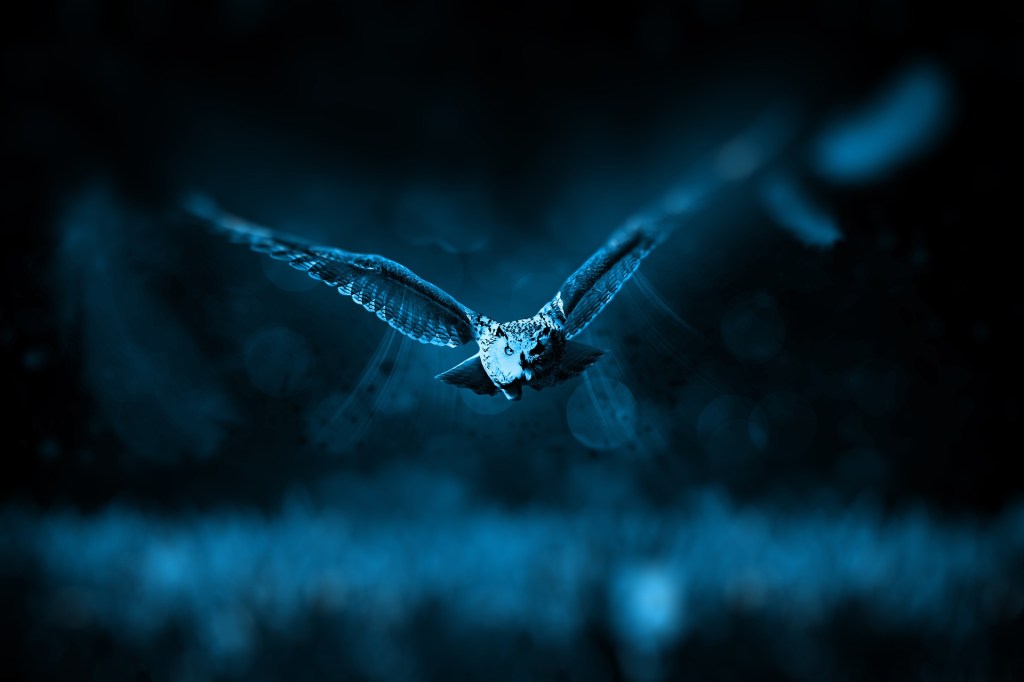
La Lechuza can be either a woman who learns to turn into an owl or vice versa, and according to legend will only change form if paid to, otherwise they lose their power. Some stories claim that Las Lechuzas are the women that were murdered by their lovers and seek revenge. Others say they are just women who delve too deep into dark magics. One of the more popular explanations is that they were women who practiced witchcraft and were found out by the village, who exposed and killed them. These women swore revenge on all those that harmed them and anyone else that stands in their way. Supposedly there is an organized cabal of shapeshifting Lechuza women, so they can potentially hunt in packs if necessary.
Las Lechuzas are thought to feed on humans and will hunt them in the dark or try to lure them out of their homes by making the sounds of something in distress, like a crying baby or a kitten or puppy. Lechuza is thought to control the souls of men and often lead them to their death, though that aspect comes off a little cloudy, as La Lechuza is more about doing the job she is paid for rather than her own moral code. Her reputation for evil is more linked to her unnatural powers and her willingness to take on any task for payment rather than her own desires for revenge or suffering.

Supposedly they only hunt people who have caused harm to women or have evil in their heart, so there is some relief there for the virtuous among us. Regardless of the individual though, seeing la lechuza is never a positive sign, and usually a portent of a coming tragedy. Unfortunately, even the eyewitnesses of la lechuza that were not attacked seldom seem to be long for this world, suffering seemingly unrelated accidents or violence shortly after.
More modern tales tell of La Lechuza involve the old ‘high strangeness’ chestnut of draining the power from a car battery, stranding a potential victim and forcing them to go for help on foot. Traditional tales speak of la lechuza having control over thunder and lightning, so there seem to be some interesting parallels there with control of electricity. Unusual thunderstorm patterns can be a sign that la lechuza is nearby, as well as spotting the shadow of a large bird, or even hearing birds singing at night.
Should you happen to find yourself hunted by la lechuza, the first rule is to never attack them head-on. They can easily overpower a human and are immune to non-magical weapons. Lines of salt will prevent their crossing, as it will most malevolent magics. Never make eye contact, as that is said to be how they gain control over your soul or in some cases learn to take your appearance. Funnily enough, they appear to hate to be sworn at, so the best defense against them is to let your foul mouth fly and it will likely run la lechuza off.

Tah-tah-kle’-ah
Tah-tah-kle’-ah is a species of horrible and powerful owl women monsters talked about by the Yakama tribe form the territory today covering Southern Washington and Northern Oregon. There are many parallels with a creature called sne-nah by the Okanagans, whose territory was in nearby modern British Columbia. The most famous accounts of the tah-tah-kle’-ah come from an account taken by L.V. McWhorter from Yakama tribesman William Charley in 1918.
L.V. McWhorter was an early 20th-century farmer who became interested in the native culture of first the tribes in his native West Virginia and later in the plateau tribes of Washington. He recorded many of their tales and became a vocal advocate for the mistreatment these tribes suffered at the hands of the American government. Though an amateur, his early dedication to recording the native tales long before many other white men cared to has earned his writings a place in the Washington State University special collections.
Unfortunately, my investigation of William Charlie turned up nothing, but the following story is reportedly in his words:
“Before the tribes lived peaceably in this country, before the last creation, there were certain people who ate Indians whenever they could get them. They preferred and hunted children, as better eating.

“These people, the Tah-tah kle’ -ah, were taller and larger than the common human. They ate every bad thing known such as frogs, lizards, snakes, and other things that Indians do not eat. They talked the Indian language, and in that way might fool the Indians. There were five of them, all sisters. But at the last creation they came up only in California. Two were seen there. They were women, tall big, women, who lived in a cave.
“One time the Shastas (Shasta Indians) were digging roots and camped. They knew that the two Tah-tah kle’ -ah were about, were in that place. The Indians were careful, but the Tah-tah kle’-ah caught one little boy, not to eat, but to raise up and live with them. The boy thought he would be killed, but he was not.
“The Tah-tah kle’-ah had him several days. One day, when they were out of sight, the boy hurried away. He ran fast, traveled over rough, wild places, and at last reached his own people.
“After many years the two Tah-tah-kle’-ah were destroyed. None knew how, but perhaps by a higher power. Their cave home became red hot and blew out. The monster-women were never seen again, never more heard of but they have always been talked about as the most dangerous beings on earth.
“One other of the five sisters was drowned. From her eye, all owls were created. The person or power that killed her said to her, ‘From now on, your eye will be the only part of you to act. At night it will go to certain birds, the owls’.
“Owl [Sho-pow’-tan] was the man. He was a big chief who lived at Po-ye-koosen. He went up the Naches [river?] to hunt deer. Many men went with him. They hunted all one sun, and when evening came, Owl did not return to camp. The hunters called to each other, ‘Owl is not here! Owl is away! Owl is lost!’
Tah-tah-kle’-ah, the evil old woman with her basket, heard that call in the twilight, ‘Owl is lost!’ And she said to her four sisters, ‘We must go hunt Owl who is lost from his people. We will get him for ourselves’.
“Owl knew that Tah-tah-kle’-ah was coming for him; so he went up to a hollow place in the Tic-te’ ah. You can see the trail that he traveled up the face of the rock to the cave high up in the wall of Tic-te’ ah. Grass is growing along the narrow trail. You can see it when you are out from the rock where it winds up the cliff.
“Owl had killed a deer. He filled the tripe with the blood of the deer. He heard Tah-tah-kle’-ah coming, and he knew she would kill him. He knew, and he placed the blood-filled tripe in front of him. Tah-tah-kle’-ah entered the mouth of the cave. She looked. It was dark, but she saw it, the strange thing lying there. She did not know. She was afraid. She called to Owl, ‘Take it away! I do not like it!’
“Owl said, ‘No! That is something powerful, step over it.’ Tah-tah-kle’-ah did as told, stepped her foot over the tripe. Owl was ready. He did not get up. He sat there; and when the Tah-tah-kle’-ah stepped, he punched the tripe with his stick. He punched it often and it went, ‘Kloup! kloup! Kloup!’
“Tah-tah-kle’-ah was scared! she screamed, threw up her hands, and fell from the cliff. The wana [river] ran by the base of the cliff, deep and swift. Tah-tah-kle’-ah fell into the water and was killed.”

Stikini
The Stikini is a terrifying vampiric owl-person primarily known to the Seminole people of modern Florida, though there is some overlap with the Creek of modern Oklahoma, and the tale has spread some to swamp inhabiting tribes in New Jersey and Michigan.
Stikini are witches that have transformed themselves into giant undead owl-like monsters. These reanimated dead spend the nights hunting for human hearts to devour, and to hear their cry is to be marked for imminent death. Much like the infamous Skinwalkers among the Navajo tribe, the Seminole rarely speak their name, for fear of attracting their attention.

The stikini are completely indistinguishable from normal humans in the daytime, but at nighttime they vomit up their internal organs, blood, and soul, which is what allows them to transform into great horned owls and go hunting for sleeping humans. As with la lechuza, stikini can transform into any animal they wish, but prefer the visage of a giant owl. They hide their organs and innards up in the treetops to keep animals from eating them as well as away from others who would do them harm.
The stikini removes its victim’s heart through their mouth and returns with it to their lair where they cook it in an enchanted pot. Afterwards they can consume it and absorb their victim’s life force. Before sunrise, they must regather and swallow all their innards to again return to their human guise.
To defeat a stikini, one must first locate its organs. You can try to hide them or keep them from the stikini, as sunlight will destroy them if the sun rises before they have transformed back into human form, but a stikini will be able to sense its organs’ location and you may have vicious life-and-death battle on your hands. The safest method of killing a stikini is said to be to prepare magical arrows, decorated with owl feathers, blessed and dressed with sacred herbs. Then wait near the stikini’s organs and shoot the monster while it is swallowing its organs. This appears to be when it is at its most vulnerable.
Cover photo by Dušan veverkolog on Unsplash
 The Booze + Spirits Podcast