Tag Archives: Tales

Ghost Critters of Texas

Shortly before we put the podcast on ‘indefinite hiatus’, one of the show ideas we were discussing was ghost animals, especially once one of us came across a tale of a ghost cow–after all, who doesn’t want to know about a ghost cow?

The ghost cow, unfortunately, wasn’t a huge story on its own, but since it came out of Texas, it lent itself to a collection of stories about Texas and its numerous ghostly animals.

Image by Tanja Schulte from Pixabay

Ghost Cows of Farm Road 511

Farm Road 511 sits at nine-and-a-quarter miles long and runs along the northeast edge of Brownsville, in Cameron County. During the day, it serves as a normal if not fairly busy farm-to-market access road, but the locals will warn travelers to avoid it at night, as the local spirits like to cause trouble for unsuspecting drivers.

Certain dark and desolate stretches of the road are known to provide drivers, particularly the unwary, with a sudden encounter with ghost cattle–and when we say sudden, we mean ‘in-the-middle-of-the-road, appearing-feet-from-the-bumper, jerk-the-wheel-to-avoid-a-collision’ sudden. Many drivers have spun the wheel to avoid suddenly crashing into the spectral cattle, often flying off the road and wrecking their vehicle regardless. Accident or no, when the travelers check their mirrors or get out of the car, no evidence exists that any cattle has been there, living or dead.

As the ghost cows have a tendency to cause vehicular accidents, they come with a steady danger of property damage, injury, or even death, making them one of the more dangerous of all of Texas’s ghost animals.

Image by Thanks for your recognition • Donations ♡ welcome from Pixabay

Brush Arbor Ghost Turkey

This one barely seems worth mentioning, but in the interest of completeness we have the tale of a supposed phantom turkey near Elkhart.

A particular area of unsettled land covered in thick trees there is known to the locals simply as the Brush Arbor. Many ghost stories are attached to the Brush Arbor, in no small part thanks to an unfortunately now-deceased but once extraordinarily active local storyteller by the name of James “Toodler” Rials. Ol’ Toodler liked to tell of a doctor that lived and worked in the countryside surrounding Elkhart at the turn of the 19th century known as John Harper Paxton. Paxton would often pass the Brush Arbor as he crisscrossed the county, and reportedly saw former, long dead patients of his on multiple occasions dwelling in the Brush Arbor, looking longingly at him as though they were awaiting one last diagnosis–perhaps a second opinion on their apparently vacant mortality.

The Brush Arbor itself is primarily habitat for smaller mammals: squirrels, racoons, possums and the like. Whitetail deer might pass through on occasion but were scarce. The area could have once been a great home for black bear and wild turkey, but they were hunted out of the area sometime before the 20th century.

Image by blackrabbitkdj from Pixabay

So, when Toodler’s own uncle, Redger Daniels, went hunting there in his youth sometime in the 1930’s, a chill ran down his spine when he heard the call of a tom turkey calling through the thick hardwood forest. Even more suspicious was that the gobbling was followed by a tinkling noise, like several small bells.

Sure, an unidentified turkey call in dense woods may seem a silly thing to frighten a person, but maybe Redger’s subconscious knew something his forebrain didn’t pick up on. Between Dr. Paxton’s deceased patients and Redgers’ exceptionally rare game, is it possible something more sinister waits in the Brush Arbor, trying to lure people in?

Image by LUIS ALFREDO RODRIGUEZ AGUAS from Pixabay

Ghost Monkey Bridge

At the intersection of Wilson and West College Streets, a trail lies beaten into the brush behind a roadblock where once West College Street changed into Farm Road 1500. Where the decomposing road meets the nearby railroad tracks, the remnants of an old bridge known to the locals as “Monkey Bridge” slowly disintegrates.

Tales tell that sometime in Athens’s past, a circus train was passing through town when some of the cars derailed and a car containing show monkeys broke open and its primate occupants escaped captivity. Most tales say they fled to the nearby trees; some tales say they took bloody revenge on their owners first. Perhaps the wildest tales are that they were recaptured by a local preacher, Reverend Fuller, and took him to his nearby parcel which he called Fuller Park, where he kept some on display in a cage and others he conducted horrible experiments on in the pentagram arranged tunnels beneath the park. (That last tale may have gotten jazzed up by local urban legend tellers a bit more than the others.)

Despite the wildest of accusations, the area around the bridge has the kind of mystique that local teens looking to prove their courage gravitate towards, often at the defiance of warnings from wiser and more experienced adults. Reports of phantom screams, both man and monkey, have been reported coming from the imperceptibly thick brush around the area. One resident even has a story of visiting the bridge at night only to be chased away by a violent man in a monkey mask.

Whatever the case, the Monkey Bridge is the kind of place that local youth both fear but can’t help to be fascinated by.

Image by Wolfgang R. Zissler from Pixabay

Santa Anna’s Ghostly Guard Dogs

The Texas Revolution began in 1835, as American settlers in Texas refused to pay taxes and tariffs to the ruling Mexican government, claiming that Mexico was doing nothing for these people living on its far northern frontier. President Antonio López de Santa Anna repealed the constitution, and to put the rebellious Texans back under control gathered a large army by supplementing his own forces with hired convicts, derelicts, and a large number of natives (the latter of whom didn’t really understand Spanish commands).

Despite some bloody victories at The Alamo and Goliad, Santa Anna’s army stretched beyond their supplies, expertise, and capability to the breaking point. In the end, the smaller and less experienced Texian Army and Navy got the upper hand, and Santa Anna himself was captured the day after his defeat at the Battle of San Jacinto despite disguising himself as a lowly dragoon. After an attempted suicide, Santa Anna was cared for by Texian Army surgeon James Aeneas Phelps, and it was agreed to move El Presidente’s imprisonment to Phelps’s plantation in Brazoria County.

Supposedly, a Mexican officer gathered a rescue party with the intention of riding to Phelps’s plantation, Orozimbo, and rescuing their captured leader. The group waited until just before dawn, when most of the plantation was asleep. But when they started to make their approach, the frantic braying of hounds abruptly broke the morning silence, rousing the guards and scaring off the would-be rescuers. This might be a fairly mundane incident were it not for the fact that there were no kept dogs in the area, not at Orozimbo or for many miles away.

Photo by Matt Hill

One servant claimed to have spied the three animals–two with shaggy coats and one hairless, and all ghostly white–and claimed that they had wild, frightening eyes. The animals matched the description of three dogs that belonged to a who had been killed at Goliad, that reportedly refused to eat or come inside after their master left for battle. One day they just disappeared, not to be seen again until the incident at Orozimbo.

From then on, they would be spotted occasionally in the forests near Orozimbo, but never again was their barking heard. As recently as 1974 a couple saw them near the cemetery and ancient oak tree that serve as the last remnants of Orozimbo. Some say that they remain as ever watchful eyes to the area, just as they were when Santa Anna was imprisoned there.

Image by Patou Ricard from Pixabay

The Ghost Horse of the Llano Estacado

If you think about the symbols of American freedom, an entire library of images may come to mind, but perhaps the most stoic and reserved still lies with a herd of wild horses galloping across the American plains. Reintroduced to the Americas by European settlers and explorers, it was only a matter of time before a steady trickle of escaped horses found their way into the wild and began to reclaim the land of their ancestors. Today there’s about 72,000 wild horses running across publicly protected lands in the United States, but this is the story of one very special one.

The legend of the Ghost Horse started sometime in the second half of the 1800’s, with legends of a huge mustang the color of pale cream or white snow and ran with such grace that he appeared to glide rather than work his legs. He was known by many names: the White Steed of the Prairies, the Pacing White Stallion, the Ghost Horse of the Plains, the White Shadow, the Winged Steed, and Wind Drinker

Ranchers, horse racers, vaqueros, and all manner of horse handlers knew that Wind Drinker would be a magnificent prize, both as a specimen and as breeding stock, but despite an assortment of tricks and traps, the great horse would always just simply glide away at gale pace. Native trackers were hired to help capture the beast, but upon viewing it they deemed it possessing “unspeakable medicine” and abandoned the project.

Perhaps the most well-known tale of the Wind Drinker’s attempted capture comes from before the American Civil War, and involves a couple of fellows from outside Texas: a fiddle-player from out east named Kentuck and an Arkansas gambler named Jake. Hearing the tales of the ghost horse the two started seeing dollar signs in their eyes and quickly gathered four strong distance horses, some pack mules, and enough supplies to last them half a year in the wilderness. Jake was particularly dedicated to being the man who would tame the animal. “I don’t know exactly where to hunt,” he supposedly said, “but we’ll ride on the prairies until we find the horse or until they are burned crisp by the fires of Judgement Day.”

It took them weeks to arrive at Liano Estacado in the Texas panhandle, and as the weeks turned to months without sightings, Kentuck’s resolve wavered. Jake would often chide Kentuck until he quit complaining, but in the end Jake was right. One rainy evening as the duo sat trying to warm themselves around a buffalo chip fire, they glimpsed the great white horse. At first, Kentuck thought it was Indians when Jake signaled him to look and made for his mount, but them he saw it. “My eyes picked up the white horse,” Kentuck later said. “He stood there to the southwest, maybe a hundred yards off, head lifted, facing us, as motionless as a statue. In the white moonlight, his proportions were all that the tales had given him. He did not move until Jake moved toward him.”

The horse fled, and Jake and Kentuck gave chase. The white beast again seemed to glide across the landscape, and the duo could never manage to close the distance on him–they would ride harder and the mustang would easily match their speed. Foreboding eventually creeped down Kentuck’s spine, and he yelled out at Jake, “There’s no sense to it. I’m remembering things we’ve both heard. Let’s stop. We can’t no more catch up to him than with our own shadows.”

Image by Victoria from Pixabay

But Jake had come so close after so much work, he refused to slide backwards in his quest. He yelled back, “I told you I’m going to follow till the Day of Judgement!” 

Kentuck continued the pursuit, though perhaps not as furiously as his partner, allowing himself to drift back a bit. The world grew silent, the sound of hoofbeats the only noise either of them could hear. As the beast and its pursuers raged on, Kentuck saw a cliff lying in front of them, and felt relief as he was sure the chase would finally end. But that relief quickly got swallowed by terror as he realized neither the Ghost Horse nor Jake was slowing down any.

“Jake, watch out for the canyon!” he yelled, but it was too late, and Jake and his mount flew off the edge and into the dark emptiness of the Palo Duro Canyon.

Reaching the edge, Kentuck was unable to see the bottom, and somehow in the confusion had lost sight of the Ghost Horse as well, his attention solely on his partner’s impending doom. He waited until the light of dawn, when he could find a game trail that led him to the bottom of the canyon, where he found the remains of Jake and the horse he rode into Judgement Day. Kentuck buried them both in a makeshift grave.

Today, campers and hikers in Palo Duro Canyon still report hearing the thunder of hoofbeats on occasion and have even reported seeing a ghostly white horse running the nearby plains and canyon’s edge. A handful of times witnesses have even seen a ghostly cowboy riding in hot pursuit, doomed to chase a beast that it appears he will never catch.

Featured image by Michal Jarmoluk from Pixabay

Image by Gábor Bejó from Pixabay

Wolf Creek Inn

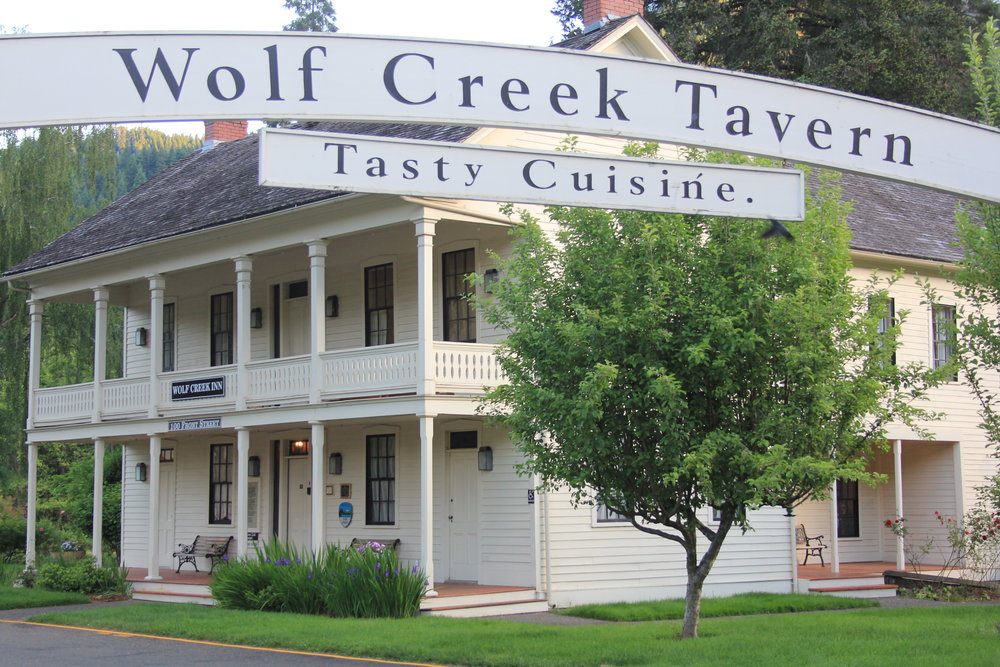
The Wolf Creek Inn lies in Wolf Creek, OR, just off Interstate 5 on Exit 71. It is a two-story Classic Revival style clapboard inn that serves as a bed and breakfast, restaurant, community event center, and museum. Wolf Creek Inn is the longest still-running inn and restaurant in Oregon history.

The lodge began life as a clap-board lodge built in the early 1850’s offering rest along the Applegate Trail. In 1883 it was converted from a “Six Bit House” into a first-class hotel by orchardist Henry Smith. Pear and apple trees survive to this day near the Inn that were originally planted by Smith. Christened the “Wolf Creek Tavern”, the stagecoach stop was built up with 16 rooms, separate men and women’s parlors, a dining room, and a deluxe outhouse just outside the back door as a respite along the sixteen-day coach route between Portland and San Francisco.

Image from Wolf Creek Inn’s website

Working cowboys would be allowed to stay in the attic for 10-cents a night, but the attic was unfloored, leaving only a “shelf” of two or three boards around the perimeter of the attic for the cowboys to sleep. To keep from rolling off in their sleep, the cowboys would jam their spurs into the rafters, the marks of which still remain. In 1925, then owners John and Dinky Dougal constructed the South Wing along with the famous “Tasty Cuisine” sign, and the inn grew in popularity as a retreat for writers, artists, and actors.

Famous guests to Wolf Creek Inn include: Mary Pickford, Douglas Fairbanks, Orson Welles, John Wayne, Sir Anthony Hopkins, Sinclair Lewis, and President Rutherford B. Hayes. The entire cast of “Gunsmoke” stayed in the inn once while shooting an episode in the nearby ghost town of Golden. Clarke Gable and Carole Lombard were said to be regulars of the establishment, Gable famously befriending the innkeeper and regularly slipping away to go fishing on the Rogue River. Some claim that Clark would occasionally sneak off to Wolf Creek for extramarital dalliances, but it’s also claimed Gable came here to grieve after Lombard’s passing.

Photo by Caleb Falkenhagen

Jack London was one of the inn’s most frequent lodgers and spent an entire summer there with his second wife while he wrote the short story “The End of the Story” and finished “Valley of the Moon”. His room has been preserved to appear much as it would have during his visits, and some say his ghost returned to the Inn after his death in 1916. Guests have reported encountering London’s apparition in his room, and his voice has been heard as well.

Dinky Dougal gave birth to their daughter Jane in the Mary Pickford room. Jane revisited the Inn in the late 1900’s and recalled how Dinky’s cooking would attract the wolves nearby to hang out in the yard, hoping for a snack. Wolf Creek was named naturally for the large number of wolves in the area at its founding, and guests to the inn in early days were each given a chamber pot for use during the night, since leaving the safety of the building to use the outhouse could be hazardous. The last recorded sighting of a wolf near the Inn was 1956.

Another commonly encountered ghost is the spirit of a female stagecoach driver, who people like to associate with One-Eyed Charley. ‘One-Eyed Charley’ Parkhurst was a well-known stagecoach driver on the roads south of Oregon during the Gold Rush. Charley had a reputation for being a real roughneck, described as a man that “drove his team hard, spat his tobacco juice harder, and cussed like Sam Clemens”. Charley registered to vote for the first time in 1868 to cast a ballot for Ulysses S. Grant and was known to only miss work on the day after payday (due to being hungover).

Image by Sabrina Eickhoff from Pixabay

When One-Eyed Charley died at the age of 67, the mortician was shocked to learn that ‘Charley’ was actually ‘Charlotte’. Originally an orphan girl, Charley left the orphanage and got into stagecoach driving by dressing and acting like a man. Since Charley proudly voted for Grant in 1868, that potentially makes her the first woman in the US to vote in a presidential election.

The lady stagecoach driver’s voice is often said to be heard in the building when no one is around. She is described as sounding like a little kid singing, kind of playing around, and is often seen in the window from outside. It has not escaped more astute historians that there is one major hang-up in the story: One-Eyed Charley died in 1879, before the Inn was constructed. But since the Inn was converted from the original clapboard lodge form the 1850’s, perhaps there’s enough leeway to not squelch the story out over that detail just yet.

Other ghosts reported include a young woman who has been seen in Clark Gable’s room, and an older man who has been seen inside the building. Both have been caught on EVPs. The building has the full complement of randomized haunting reports: doors opening and closing, phantom scents, lights flickering, piano playing, small items moving on their own. Children are sometimes heard playing in the Ballroom. EVP’s captures are not uncommon for paranormal investigators, including one that reportedly said the name “Beulah”, so there’s speculation that it might be one of the spirits’ names. The kitchen is often reported to have items thrown around the room or people preparing meals may brush across someone who isn’t there. Some guess Dinky Dougal is still overseeing food preparation in the kitchen that meant the world to her.

Image by Eden Moon from Pixabay

A more sinister spirit has also been described on the grounds and even within the inn, described as a “vampire-like creature” with the stature of a small man, with ghoulish fangs and blood around its mouth. It has been suggested to be a spirit-of-the-woods or some kind of cryptid, but most people reckon that it is simply the ghost of a mentally disturbed person wishing for witnesses to perceive him as a monster.

There are a few amateur paranormal investigations of Wolf Creek Inn on YouTube one can sift through, and they are about what you would expect: people fumbling to use tarot cards and dowsing rods they’ve never touched before, using ghost hunting phone apps and identifying EVPs that somehow don’t turn up in editing.

Photo by Dan Meyers on Unsplash

There is also an investigation by paranormal punching bags and douche squad extraordinaire, Ghost Adventures. Zak Bagans, of course, is on the scene for all of six minutes before finding a “portal” no one else in all of history has identified, decides that the reported little girl ghost is actually a demon in disguise protecting the portal, and then spends the rest of the episode going after this demon that only he has ever identified there.

In the 1960’s Interstate 5 came through the area, pulling away customers that would go directly past the Inn on old Highway 99, but being only a few hundred feet away from I-5 kept it in close enough proximity to survive. It was added to the National Registry of Historic Places in 1972, and in 1979, the Oregon Department of Parks & Recreation purchased the Inn to gave it a complete historic renovation. Today, the Inn still takes lodgers (ghost hunting tourists should try to get a reservation in Rooms 6, 8, or 9), and offers self-guided tours of the building Thursday thru Sunday.

Featured image by Marek Szturc on Unsplash

Image by Pexels from Pixabay
Julie on the Rooftop

This story first appeared in Ep. 001 – Rooftop Lady.

There’s a house on 734 Royal St. in New Orleans with a very peculiar ghost. She appears as a beautiful golden woman, sitting or walking in the building’s roof top, and apart from a pair of hoop earrings, she’s completely naked.

According to legend, the woman is named Julie, and she was madly in love with the building’s owner, a wealthy businessman by the name of Zachary. Depending on the telling, Julie is either a slave or a well-to-do lady, and is usually described as being of mixed-race, contributing to her golden hue.

The tale goes back to the 1850’s. Julie was in love with Zachary and wanted to be his wife, but to Zachary she was just a plaything, an object for a few moments of fun and nothing more. Their trysts would occur on the building’s third floor, and Julie was forbidden from visiting the lower levels. Zachary would often meet with her secretly on her floor, then return to the lower floor where he’d be having grand parties and or sometimes long chess games with his friends.

Eventually, one December night, Julie lays down an ultimatum, demanding that Zachary marries her. Hoping he can finally get her to drop the subject, he says he’ll only marry her if she strips naked, climbs out of the roof, and stays there all night to prove her love.

Zachary figured the notion was settled, and left downstairs to see to his other guests, but Julie was too determined to back out now. She stripped buck naked, climbed out onto the slanted roof, and spent the night out there, where she sadly died of exposure before the sun came up.

The next winter was the first time her ghost appeared. People reported a slender, naked, golden skinned woman wearing only hoop earrings, huddled up and pacing the roof trying to build up some body heat. Often times people even reported seeing her collapse up there.

Other apparitions associated with Julie include an ethereal chessboard in the third story windows seen on stormy nights, sometimes being played by a man or two. There have also been reports of Zachary being seen through the windows of the building or wandering in the garden below.

Witnesses to Julie’s appearances continue to this day, and local lore says if you write her a note on yellow paper with blue ink about your love problems and leave it next to the house, she may solve it for you.

Featured photo by KEN COOPER from Pexels. 734 Royal St. is a privately owned building today, so please don’t harass the residents about ghost hunting.

The Red Ghost

This tale was originally featured in Episode 004 – The Hair of the Camel.

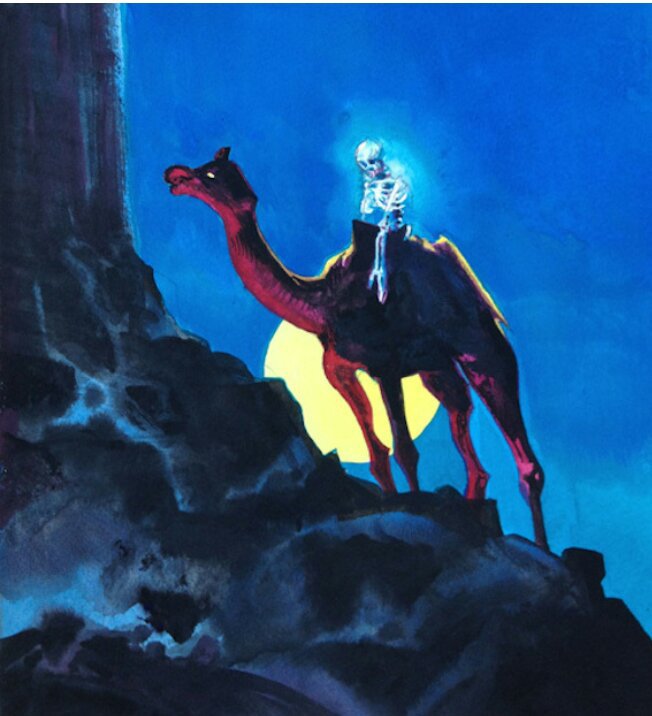
The Red Ghost terrorized Arizona during the 1880’s. The first reported appearance is in 1883, when it trampled a woman to death and left traces of red hair stuck to nearby tall grass at the scene. Later, a cowboy tried to rope the beast, but it turned and charged him, killing the man and his mount. A group of miners pursued it along the Verde River. It evaded capture, but shook something loose off of its back, a rotted human skull with dried skin and patches of hair stuck to it.

As sightings continued, the legend grew. Most described it as a great red demon with the devil himself riding on its back. Some witnesses claimed it was 30 feet tall. Other stories said that it had fought and devoured a grizzly, and that it could vanish before your eyes.

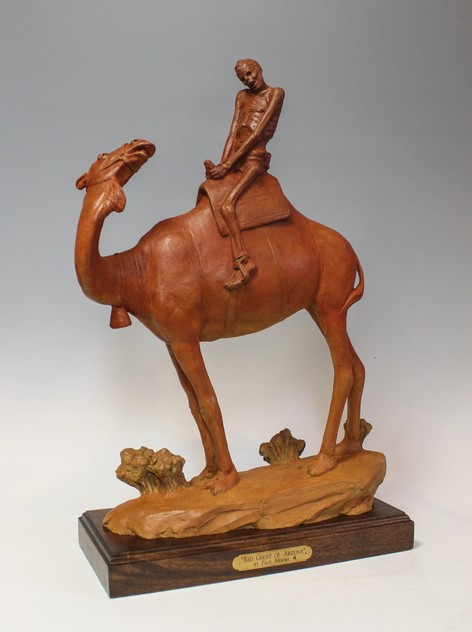
The Red Ghost’s reign of terror finally ended when a rancher in Eagle Creek caught it feasting on vegetables in his garden and shot at it, killing it dead. It was then that the Ghost’s true nature was revealed. It was a large camel, with gruesome straps of rawhide criss-crossing and digging into its body. The rawhide straps were apparently used to lash a human body, now in extreme decay, to the camel’s back. But how did such a creature in up in late 19th century Arizona?

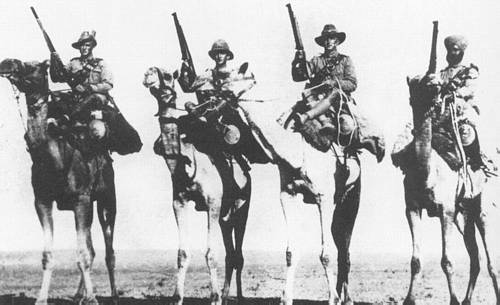
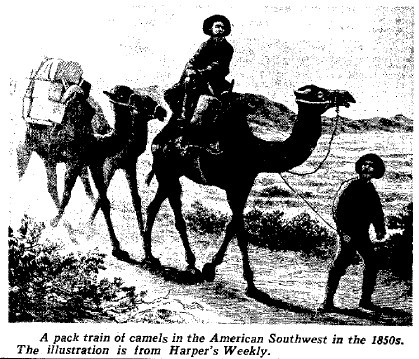
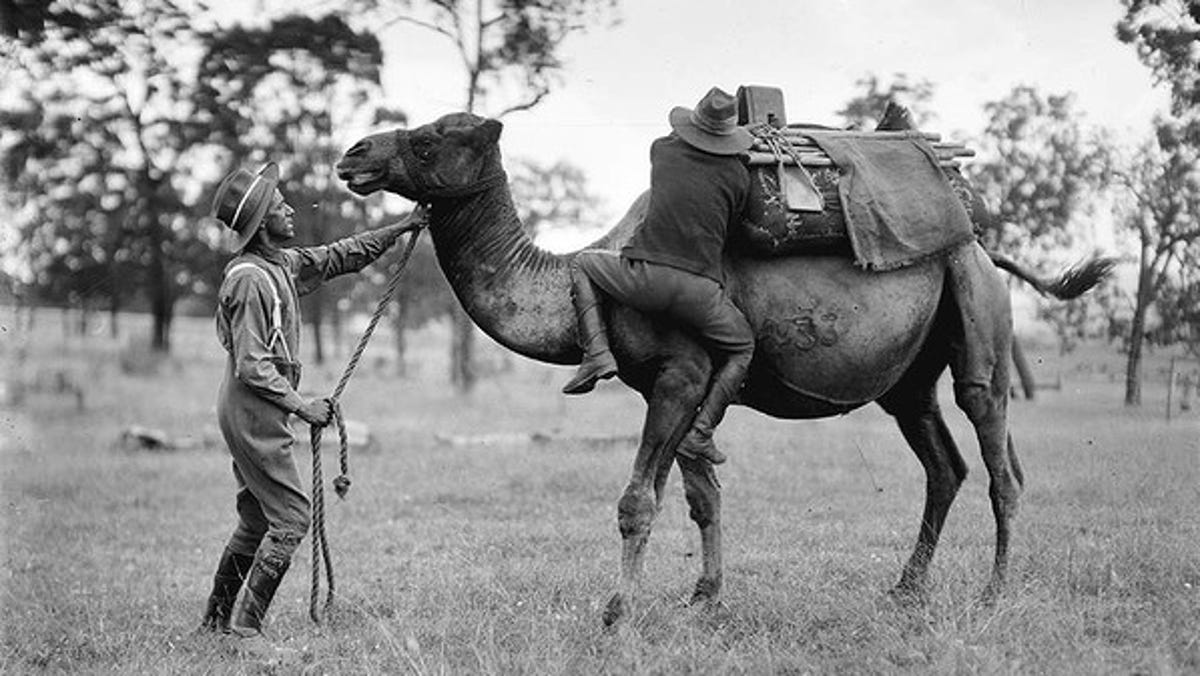
For that answer, we have to go back decades, to a pre-Civil War America. In 1853, Secretary of War and future Confederate president, Jefferson Davis got approval from Congress, after much lobbying, to spend $30,000 on the importation of camels and dromedaries for military purposes. This was still decades before the transcontinental railroad, and Davis saw the camels as the key to westward expansion, especially through the arid southwest deserts. By 1857, 75 camels had been imported to America under the plan. Unfortunately, within a decade the initiative would be scrapped and all camels auctioned off.

Despite its epitaph, the program was largely successful. The camels were stationed with a U.S. Army at Camp Verde in Texas. The camels’ primary use was to strengthen current travel routes and poke and prod out new ones west to the Pacific and south to Mexico.

Two dozen of these camels made the famous trek to Fort Tejon outside Los Angeles under the usage of hero of the west Edward Beale. Beale’s troupe made the 1500 mile trek in just three months, a feat considered impossible at the time. The route discovered by Beale’s camel caravan was used to create the Beale Wagon Road, guiding thousands of settlers out west, and parts were adopted to make the Santa Fe Railroad’s contribution to the transcontinental railroad, and eventually Route 66 and Interstate 40.

The camels did have downsides, though. They were renowned for scaring the hell out of the horses, and given half-a-chance would just wander off overnight. Of course, this is all to say nothing of a pack animal that can spit with pinpoint accuracy at any handler it doesn’t agree with.

But the real straw that broke the camel program’s back came as Congress became afraid to pursue further importation of the animals due to pressure placed on them from lobbyists in the mule industry. Though this was plenty, further complications came from the secession of Texas and the South, causing Camp Verde to fall into the hands of the Confederacy. Left to Confederate care, the camels’ security was more lax, and many if them simply wandered off when let loose to graze.

The camel unit quickly scattered throughout the region. Union forces re-captured three of the beasts in Arkansas, but quickly auctioned then off. Some camels made it to Mexico, reportedly. A few found employment in the Confederate Postal Service. One, nicknamed Old Douglas, became the property of the 43rd Mississippi Infantry and was killed during the siege of Vicksburg, an act which so enraged Confederste Colonel Bevier that he tasked six of his best snipers with identifying and killing the Union sharpshooter that gunned Douglas down.

Some escaped camels turned feral and survived in the wilderness, but they never had enough numbers to provide a thriving and lasting sustainable herd. People would have chance encounters with these wild camels from time-to-time, the last report of such coming from the mid-20th century.

The origin of The Red Ghost himself is still something of a mystery. One rumor is that the rider was an Army soldier who was deathly afraid of the camels, so his fellow soldiers tied him to the back so he wouldn’t have to worry about falling off. Unfortunately, the beast took off and the soldiers were unable to keep up pursuit.

This seems a pretty poor explanation under scrutiny, though, because it relies on a soldier being tied on top in such a way that he couldn’t get himself off. It’s hard to image an arrangement under friendly intentions where the rider would not be given means to remove himself from the beast’s back. 

Another tale tells of a rider that was too tired to hold onto the beast and decide to tie himself on instead, but again that would leave us a rider that should be able to get himself loose before death set in. A more likely incident might be a screwball episode of frontier justice, or maybe a death sentence created by a particularly creative and sadistic outlaw, either one a situation where an individual would be attached to an animal without means of removing themselves, then the animal set loose with no destination in mind. Whatever the story, the rider’s fate and identity were never discovered. And despite The Red Ghost’s capture and killing, reports of a red camel being ridden by a skeleton persisted for years afterwards.

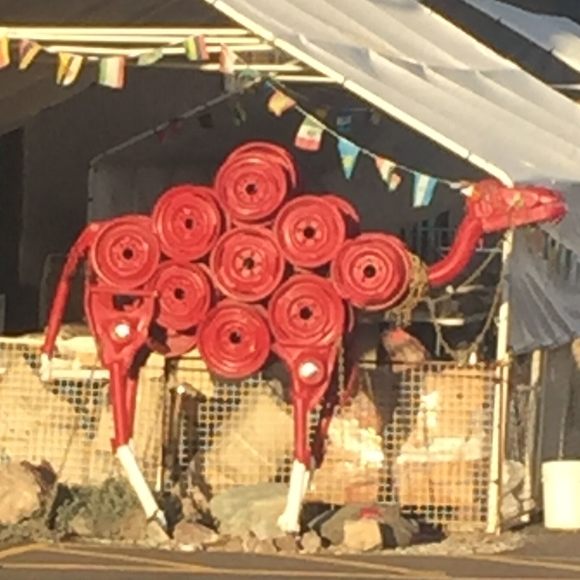
Today, a bright red scrap metal sculpture of The Red Ghost sits in Quartzside, AZ, where it has been lovingly named Georgette. Old Douglas has a grave in Cedar Hill Cemetery in Vicksburg, Mississippi, somehow fittingly as it’s Jefferson Davis’s hometown.

Interestingly enough, though, another ghost story has sprung forth from the history of these imported camels. Three camels were purportedly purchased from an Army auction by a prospector by the name of Jake. The soldiers warned Jake that the camels were quite ornery, but Jake took good care of them and never had anything but praise for them and their behavior.

Eventually, Jake hit pay dirt and led his camels into town, laden in gold for the exchange. This caught the attention of a would-be claim jumper named Paul Adams. He heard of Jake’s success and decided to follow him and his camels out of town.

Jake was smart enough to not head directly to his claim, and instead took a long, circular route, so long that he ended up having to camp for the night. Mistaking the temporary camp site for the actual gold claim, Adams snuck in and murdered Jake. Trying to protect his owner, one of the camels attacked Adams, biting him, but eventually getting gunned down as well.

It wasn’t long before Adams realized his mistake, that this wasn’t the claim, and spent the next few days searching the nearby area, vainly trying to locate the real spot. It was on one night of searching that Paul Adams was awoken and saw the ghost of Jake on the back of his camel looking over the murderer. He quickly mounted his horse and fled, but the galloping camel continued the chase, unrelenting until Adams rode into town. Adams was so frightened he confessed all his deeds in exchange for the protection of a sheriff’s jail cell.

Photo by Isabelle Henriques from Pexels

The CORA Tree

This tale was originally featured in Episode 006 – Macomb Smokeshow. Featured image by Tobi from Pexels

In the 1700’s a slight woman and her baby, whom she was never seen without, arrived in the community of Frisco on Hatteras Island, North Carolina. The woman, known as Cora, built a crude hut outside of town in the woods and mostly kept to herself. Her distance, both physically and socially, from the other villagers served as a catalyst for rumors to quickly form and circulate about her possibly bastard child. The Salem Witch Trials still on the mind of the American settlers, it didn’t take long for gossip about Cora to turn towards sorcery and witchcraft.

Stories persisted that a cow she touched dried up and quit producing milk days later. A child that taunted and made faces at her suddenly became ill and died. And Cora always seemed to have an abundance of fish, even as the local fishermen were unable to catch any themselves.

The rumors might have stayed just that were it not for the arrival of the ship Susan G. and her captain, Eli Blood. Hailing from Salem, Massachusetts, Blood considered himself a student of New England tradition, a defender of the people, and, of course, a witch hunter. He immediately set himself to ingratiating himself to the townspeople and working his way in with the local hobnobbers and gossip hounds.

Photo by Rachel Claire from Pexels

Of course, after hearing of the town’s troubles and of the suspicious Cora outside of town, Blood determined that she had to be the witch responsible for it all. The deal became particularly sealed when the body of a local man was found washed up on shore. His face was frozen in an expression of terror, his hands were clasped together as if he were praying, and the number 666 was carved into his forehead. Most damning of all was a collection of small footprints around the body that headed off into the woods towards Cora’s hut.

This development emboldened Captain Blood. He became sure that Cora was a witch and set out to prove it. He gathered an angry mob and marched to Cora’s hut, smashing their way inside and taking Cora and her baby prisoner. Out to prove her guilt, Blood pulled out his knife and performed the first test. As he suspected, her hair would not cut, announcing, “her hair was stronger than wire rope”. Next, Cora’s hands and feet were bound, but she floated in water regardless. In his final test, Blood filled a ceremonial witch hunter bowl with water, and placed a drop of blood each from himself and three other men into the water. He then, “stirred the water and blood vigorously, mixing it into a froth” and had the other men confirm what he saw in the bowl: the faces of Cora and the devil.

Blood and his men tied Cora and her baby to an old oak tree and began gathering firewood to place around the base. It was about this time that some of the townspeople, led by local captain Thomas Smith began to protest that Cora should be taken to the mainland and tried in a proper court of law.

An argument ensued. Blood tried to light the fire himself, but Smith grabbed his arm, keeping his torch from the pyre. Blood shook loose from Smith’s grasp, determined to burn his witch, when suddenly a bolt of lightning struck the tree. 

As the smoke cleared and the ringing of ears subsided, the people found that Cora and her baby had vanished. The ropes still hung wrapped around the tree and the kindling sat at the base completely untouched. The trunk of the tree had been ripped open by the lightning, leaving a large, smoldering, heart-shaped hole. And where Cora and her baby had been tied to the tree were left letters burnt into the wood: C-O-R-A.

The Cora Tree still exists even to this day, and the word CORA is still visible on the trunk of the great tree. The tree stands on Hatteras Island in the middle of Snug Harbor Drive in Frisco, quite literally as the road splits in two to go around it on either side.

Regarding the tree itself, it has been attributed as being both a Southern Live Oak and a Water Oak. Southern Live Oaks generally reach maturity around 70 years old, and so long as a carving on the tree is done after maturity the carving will remain for the tree’s lifespan. There are examples of Southern Live Oaks in America over 900 years old,. Water Oaks, on the other hand generally only live 100-150 years, and usually start to decay before the century mark. No known core sample has ever been taken of the tree, but in 2009 LG Research reportedly estimated the Cora Tree at around 500 years old based on its circumference.

Interestingly, the CORA carving has a lot of similarities to the CRO carving on Roanoke Island and the CROATOAN carving from Fort Raleigh. All three carvings sit about 5 feet off the ground, all are about 4 inches tall, and all share a similar lettering design. Also, artifacts discovered near Frisco matched artifacts in the other locations, suggesting the items were even cast from the same die.

Photo by Dmitry Demidov from Pexels

Neither the captains nor the Susan G. show up in any historical record, and the name Cora wasn’t common in America until the mid-1800’s, after the publishing of The Last of The Mohicans. Kora-with-a-K was a common name in 1700’s Germany, so the prospect of Cora being an immigrant, unfamiliar with the common language if the nearby village would easily explain much of her behavior.

In fact, the details of the event change wildly depending on the attitude of the storyteller. Those looking to condemn Cora tend to embellish the witchy aspects of the story. It’s not uncommon for the story to mention the baby transforming into a black, green-eyed car and running away into the woods before the lightning strike.

Retellings by more sympathetic orators tend to make note of Blood having a boastful and egotistical personality, and the suspiciousness of his crew as they stayed away from town and placed themselves in positions to help sell the more sordid details of Blood’s story. It’s also of note that this North Carolinian tale has the hot-headed Massachusetts man be the one thirsty for blood while the cooler-headed, hospitality focused Southerners were trying to push for civility and proper legal procedure.

Whatever the case, the tree still exists, and the CORA carving is visible to this day, even in photographs, a living reminder that mystery and wonder still exist in our world.

Photo by Johannes Plenio from Pexels

The Phantom Trapper of Labrador

This tale originally was told in Episode 005 – Christmas Special 2020

The Phantom Trapper is a ghost seen in the Labrador area of Canada, whose presence is often said to herald the arrival of a large storm.

The person most commonly accredited to being The Phantom Trapper was a man named Esau Gillingham. He was a Newfoundlander who would regularly cross the Straits of Belle Isle into Labrador to trap. Depending on who tells the tale, there’s two slants on the story that are usually told.

The first is that trapping never made Esau the kind of money he wanted, so he ended up setting an illegal still up in the tall spruces. This swill was a foul but effective alcohol made from pine cones, sugar, and yeast, and he called it ‘smoke’, earning him the nickname ‘Smoker’.

The other version of the tale is that he actually brought back very fine, valuable furs whenever he returned, which was kind of fortunate since in this version he was a horrible, raging, hot-headed, woman-attacking asshole. The money he and his skins brought into town were the only thing that would convince the townspeople to put up with him for a short time. But eventually his drunken and ornery side would become too much, and he would wear out his welcome and get kicked out of town until the next time he had a load of furs. He still makes and sells smoke in this version, but it ends up more a feather in his ne’er-do-well hat rather than being a key part of his origin story. In some tellings, he continued selling smoke even though he was well aware that it was poisonous. 

Photo by Roland Juhász from Pexels

Whichever the version we prefer, eventually the Mounties found Smoker’s still, smashed his kegs, and hauled him off to jail in St. John’s for a year. But that time in the cooler just gave Smoker the time he needed to plan the next stage of his evolution.

After being released, he went around begging or stealing every white husky he could in the area, building a new team of dogs–some say a team of 8 while others say as many as 14. He then made himself a suit exclusively of white animal skins, and after restarting his distilling business, painted his komatik and kegs white as well.

Now decked all in white, Smoker began selling his contraband booze again. RCMP tried several times to shut him down again, but his new white camouflaged outfit made it impossible to track him for long in the snow.

There’s several tales about how Smoker met his end. Some say he harassed the wrong innkeeper’s wife and got gunned down by her husband. Some say he got lost while out in the wilderness or maybe got caught in a vicious storm.

My version is that it was his own smoke did him in at the end. While soused on his own drink, Smoke fell off of a fish flake and broke his back. He lay, on the frozen ground, suffering and unable to move for three days. Sensing his time was drawing to a close, and having a pretty good idea what was waiting for him in the great hereafter, he shouted out, “Lord God, don’t send me to Hell! Let me drive my dogs till the end of time, and I’ll make up for all the bad I’ve done!”

Eventually Smoker’s body was found and brought back tp Newfoundland to be buried, but he would not find peace in the grave. Legend tells that even today the howl of the Labrador wind is sometimes joined by the sound of a dog team running through the night.

Some hear them passing by in the snow, while others have heard their traces slapping against the outside of their cabin. Occasionally a person might catch a glimpse of an all white dog team being driven by a figure in white furs on a white komatik, but they never leave tracks in the snow or stop on their eternal run.

Stories tell of a Labrador man who got lost in a blizzard while driving his dog team, and became desperate to find shelter. As he drove on, he was passed by a team of all white dogs piloted by a man in white furs. Sensing this was his best opportunity, he followed the team.

A half-hour later, the lost man and the white driver came upon a fishing village, and hearing the dogs a fisherman stood in the doorway of his hut to see who was approaching. The white driver continued on past with his team, but the lost driver slowed to a stop, thrilled to find shelter, and called out, “Thank you!”

“You’re welcome!” called out the fisherman. “Come in a get warm!” The lost man thanked the fisherman, but corrected him that he was calling out to the other driver. The fisherman just looked at him strangely, and said that he never saw or heard another driver.

Another story involved a man on foot who got caught in a blizzard and had nearly froze to death by the time the Phantom Trapper found him. The trapper easily picked the man up and set him on his sled, covering him with warm skins, and drove towards the nearest inn. Upon arrival, the trapper again easily picked up and carried the man inside, sitting him on a chair next to the fire. The trapper turned to the innkeeper, told him to take care of the half-dead man, and promptly disappeared into thin air.

Hero, villain, or antihero, the Phantom Trapper, or sometimes Damned Trapper, is a proud piece of local folklore. He was fictionalized in the 1972 novel White Eskimo: a Novel of Labrador, and is a respected entity in the local folklore.

Photo by Tomáš Malík from Pexels

Booze +Spirits Tales

We thought it might be a fun idea to write out some of the stories that we tell on the podcast. After all, it can be hard to retell a story solely from listening to it, especially after it’s been buffeted on all sides by profanity and inside jokes.

So, starting this week, we’ll be sharing written versions of our tales here on the website, about once or twice a week. Hope you all enjoy it!

Cover photo by Clem Onojeghuo from Pexels