
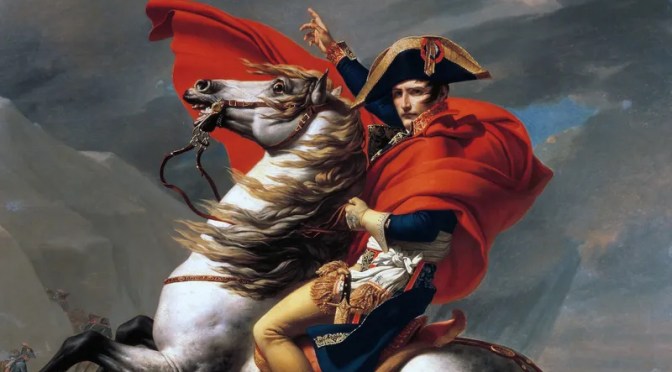
Napoleon Bonaparte: emperor, general, conqueror. At his height, France and therefore Napoleon controlled most of Western and Central Europe, as well as a colonial jewel box from the tip of South America to Indonesia second only to the British. Today, he’s largely remembered for two things: being short and being the first great example of why you don’t want to invade Russia in winter. The former is largely a misunderstanding: at 5’6”, Bonaparte was average height for a late 18th-century Frenchman, but tended to surround himself with taller generals, giving the appearance that he was shorter than the common man. The latter is a classic tale of hubris–Napoleon bet his profound gift for logistics and strategy against the resolute Russian army and their brutal climates, and lost. Unfortunately, this was all against the counsel of one of Napoleon’s greatest advisors: an ethereal dwarf known as ‘The Little Red Man of Destiny”.
Though possessing a rational mind hungry for planning and logistics, Bonaparte was also fascinated with the esoteric and otherworldly. He would regularly interpret and analyze his dreams for hidden meaning, and loved to tell ghost stories. He also claimed to be visited and advised many times by The Little Red Man, first appearing to him during the Egyptian Campaign in 1798. The creature offered Napoleon a deal: if he followed the strange man’s orders he would personally find success on the battlefield for the next ten years, and to convince the general the Little Man added that he had previously advised many of France’s greatest leaders.

“You have become far too ambitious,” the red man chided the general. “The French people are becoming wary of your overwhelming lust for power.”
“I have only ever done what was in the best interest of France and not my own, sir,” retorted Napoleon. “And how is it that you know so much of my plans?”
A smile crept across the little man’s face as he said, “I have been by your side since you were a boy. I know you better than you know yourself.”
Les Lutins
Descriptions of The Little Red Man are quite similar to another common figure in French folklore, les lutins. The lutins were said to be similar to British and Scandinavian folklore of house spirits like elves, gnomes, sprites, and hobgoblins. Occasionally they would appear as a saddled horse ready to be ridden, known as Le Cheval Bayard. Lutins are often blamed for tangling human or horse’s hair into knots while they sleep (often called elf-locks or fairy locks).

First appearing in literature between 1176 and 1181 by Benoît de Sainte-Maure as well as Wace, the lutin (also called luitin, nuiton, or netun in some texts) is described as a sea monster. In the early 14th century, “Le Chevalier de La Tour Landry” describes the ‘luitin’ as “a kind of demon, more mischievous than evil, who comes to torment people.” The name likely originates from Latin’s ‘Neptunus’, the Roman god of the seas, which in Late Latin became a catch-all term for all Pagan gods. The transition from netum to nuiton was probably influenced by Old French nuit (‘night’), and by the Old French luitier (‘to fight’).
Marie Catherine d’Aulnoy’s “Le Prince Lutin” in 1697 delved deep into the world of the lutin, describing lutin of the air, earth, and water. In the story, one lutin describes what it is to be one of their own: “You are invisible when you like it; you cross in one moment the vast space of the universe; you rise without having wings; you go through the ground without dying; you penetrate the abysses of the sea without drowning; you enter everywhere, though the windows and the doors are closed; and, when you decide to, you can let yourself be seen in your natural form.”

As the French colonized the New World, the lore of the lutin came with them. In the Americas, though occasionally appearing as a dwarf adorned in red (more on that later), lutin largely shed their humanoid appearance and adopted forms more akin to pets and local animals that would hang around homes and farms. All-white cats in particular were expected to be lutin, but any animal of distinction that was observed to stay close to human domiciles was said to likely be a lutin.
The Little Red Man of Destiny
But what of Napoleon’s Little Red Man and his claims to have influenced French leaders? The first reported encounter was with Catherine de Medici, Queen of France from 1547 to 1559 and mother to three other French Kings. She reportedly came face-to-face with the Red Man during the construction of Tuileries Palace in 1564, described as a gnome-like creature in red clothing. Catherine considered him an uninvited guest, a spirit, and overall a bad omen.
The French Wikipedia entry for Tuileries attributes the Red Man to being the ghost of Jean l’Écorcheur, a butcher that was strangled by order of Catherine de Medici herself. Jean swore to Catherine’s astrologer, Cosme Ruggieri, that he would return and that all of Tuileries inhabitants would suffer grave misfortune.

Catherine and her family indeed lived through one of the French monarchy’s most turbulent times, beset by constant civil and religious war. Italian-born Catherine, raised to be Roman Catholic, was already a sore point to the Protestant French citizenry, and she eventually encouraged her son, King Charles IX, to massacre thousands of Huguenots during St. Batholomew’s Day in 1572, a pre-emptive attack out of fear of retaliation for the supposedly Spanish papal ambush of Admiral Gaspard de Coligny. The rest of Catherine’s life in the monarchy would be punctuated by bloodshed, loss, and heartbreak.
The next sighting of The Red Man would occur in 1610. He was seen by King Henry IV shortly before his assassination at the hands of Catholic zealot and schoolteacher François Ravaillac. Queen Anne d’Autriche ran across the sprite a few days before the Fronde, a series of bloody civil wars beginning in 1648. Chambermaids of King Louis XVI encountered the Red Man in the king’s bed in 1792 while the monarch was on the run, trying to evade revolutionaries. Later that same year, Louis’s wife Marie Antoinette saw the Red Man in the corridors of Tuileries on August 9th, just one day before the revolutionaries would storm the palace and end the monarchy. A few months later guards in La Square du Temple spotted the little man, the same prison in which Louis and Marie awaited their fate. In 1817, Tuileries Palace burned to the ground and with the monarchy eliminated, The Little Red Man moved on to his newest plaything, the man who would be Emperor, Napoleon Bonaparte.

Despite Napoleon’s success in Egypt, the Little Man informed him that the fleets were not following their orders, the Egyptian Campaign would stall, and by the time he returned to France he would find her beset on all sides by England, Russia, Turkey, and their European allies. As history shows, the Red Man’s claims all proved to be true.
Despite this setback, Napoleon appeared to remain in contact with the Little Red Man through the rest of his military career. The new government residing in Tuileries was well aware of Bonaparte’s stories of encountering the Red Man and it was claimed he visited him whenever the Emperor stayed in the Palace. A sworn affidavit by Counsellor of State Louis Mathieu Count Molé said that he had heard himself the Little Red Man of Destiny meet Bonaparte shortly after the Battle of Wagram.

Wagram was a hard-fought two-day onslaught against the British and Austrian Fifth Coalition and Napoleon’s own French, German, and Italian Imperials. After the struggle ended on July 6th, 1809, the Red Man appeared again to Napoleon at midnight in his Schönbrunn headquarters. The original ten years already expended, Napoleon begged the man for a five-year extension to his contract. The Little Man agreed, but this time added the caveat that Bonaparte must never launch a campaign in Russia. Of course, we’ve already covered how that went-–it resulted in the biggest defeat of Napoleon’s career, bigger than The Battle of Waterloo.
The Little Red Man’s final appearance was on the morning of January 1, 1814. Counsellor of State Molé was approached by the Red Man, demanding to see the emperor on matters of urgent importance. Napoleon had given strict orders to not be disturbed, but when he heard who was calling he approved the visit immediately. Napoleon begged the man for more time, enough to complete a handful of proposals, but the Red Man balked at his request. Instead, the Little Man told him that he had three months to achieve peace with his enemies, or there would be consequences.

Napoleon ignored the Little Man and instead launched a new eastward campaign that failed miserably, all but delivering France into the hands of the European allies. On April 1st, three months to the day of the Red Man’s warning, the Senate called for Napoleon’s abdication, and he spent the rest of his life in exile on the isle of Saint Helena.
Le Nain Rouge
There is another place with ties to France that has a history of encounters with a little red man, and that is the area around the former French colony of Detroit, Michigan. Detroit has a long-standing tradition of encounters with Le Nain Rouge, literally “the red dwarf”, a small man dressed all in red with a gift for prophecy and a fondness for human suffering. Sound familiar?

Long treated as a bad omen or sign of misfortune, the Nain Rouge first appears in literature in 1883 in Marie Caroline Watson Hamlin’s “Legends of Le Détroit”. She describes the little man as being “very red in the face, with a bright, glistening eye; instead of burning, it froze, instead of possessing depth emitted a cold gleam like the reflection from a polished surface, bewildering and dazzling all who came within its focus.” Charles M. Skinner’s “Myths And Legends Of Our Own Land” in 1886 also mention the Nain Rouge, characterizing him as “a shambling, red-faced creature, with a cold, glittering eye and teeth protruding from a grinning mouth.” Other accounts describe him as having an animal body but a man’s face with “blazing red eyes and rotten teeth” and covered in red and black furs.
While the lutin may originate in French tradition, it appears the Nain Rouge may have as much to do with Native American legends as it does the French. Some Native stories have identified the little red man as the “impish offspring of the Stone God”. French Christian Missionaries in the region that was to later become Detroit reported finding an Idol revered by the local natives, humanoid in appearance and painted red. Natives from the Erie Band referred to it as a Manitou, a Francofied version of the Algonquin word ‘monetoo’, a catch-all word for spirits and spiritual energies. Shortly after discovery by Europeans, they destroyed the idol with an axe that had been blessed by the missionary priests. Unfortunately, this ended up creating the opposite of the desired effect, as the natives declared the area cursed as a response to the colonists’ disrespect.

Antoine de la Mothe Cadillac was reportedly advised by a fortune teller that he must appease the Nain Rouge as part of the founding of Detroit in 1701, but ignored the warning and upon encountering the little man attacked him with his cane and yelled, “Get out of my way, you red imp!” Naturally, Cadillac suffered a string of misfortune afterwards. He was charged with abuse of power in Detroit and removed from his position, reassigned to Louisiana. Eventually he returned to France, where he was imprisoned and stripped of his fortune.
After that, the appearance of the Nain Rouge would portend disaster to European settlers and their kin, particularly in violent encounters with Native Americans. The little man was spotted shortly before the Battle of Bloody Run on July 30, 1763, where the British were killed by Chief Pontiac’s men from the Ottawa Tribe. The Nain Rouge was seen again shortly after the battle, dancing among the corpses on the banks of the Detroit River, which is said to have run red for days afterwards. When Governor William Hull surrendered Detroit in the War of 1812, the Nain Rouge was blamed on a series of misfortunes that put the city in such a position. Portentous Nain Rouge sightings have persisted until at least the 20th century, with reports of the creature coming shortly before the Riots of 1967, and again in 1976 shortly before an ice storm ravaged the area.

Today, Detroit culture has made the Nain Rouge a local icon in its own right. Known as “The Demon of the Strait,” several local drinks are named after him and he has inspired a number of small budget films. Beginning in spring of 2010, Detroit has held an annual parade called the Marche du Nain Rouge, where the citizens “chase” the Nain Rouge out of town, often wearing masks and costumes so the dwarf won’t recognize them, banishing the little man from the city for another year.
So is the Little Red Man of Destiny or the Nain Rouge still out there? The people of Detroit seem to think so, and in fairness the practice of running him out of town every year seems to coincide with the city turning its luck around. Without a French monarchy to harass, he seems to have removed himself from European politics. We may just have to wait for the next disaster to befall the former French empire before we know for sure. In the meantime, the little man in red dress will have to reside in folklore… and old Twin Peaks episodes.

(Disclaimer: David Lynch is not connected to the French monarchy in any way. I checked.)
 The Booze + Spirits Podcast