Tag Archives: history

Ghost Critters of Texas

Shortly before we put the podcast on ‘indefinite hiatus’, one of the show ideas we were discussing was ghost animals, especially once one of us came across a tale of a ghost cow–after all, who doesn’t want to know about a ghost cow?

The ghost cow, unfortunately, wasn’t a huge story on its own, but since it came out of Texas, it lent itself to a collection of stories about Texas and its numerous ghostly animals.

Image by Tanja Schulte from Pixabay

Ghost Cows of Farm Road 511

Farm Road 511 sits at nine-and-a-quarter miles long and runs along the northeast edge of Brownsville, in Cameron County. During the day, it serves as a normal if not fairly busy farm-to-market access road, but the locals will warn travelers to avoid it at night, as the local spirits like to cause trouble for unsuspecting drivers.

Certain dark and desolate stretches of the road are known to provide drivers, particularly the unwary, with a sudden encounter with ghost cattle–and when we say sudden, we mean ‘in-the-middle-of-the-road, appearing-feet-from-the-bumper, jerk-the-wheel-to-avoid-a-collision’ sudden. Many drivers have spun the wheel to avoid suddenly crashing into the spectral cattle, often flying off the road and wrecking their vehicle regardless. Accident or no, when the travelers check their mirrors or get out of the car, no evidence exists that any cattle has been there, living or dead.

As the ghost cows have a tendency to cause vehicular accidents, they come with a steady danger of property damage, injury, or even death, making them one of the more dangerous of all of Texas’s ghost animals.

Image by Thanks for your recognition • Donations ♡ welcome from Pixabay

Brush Arbor Ghost Turkey

This one barely seems worth mentioning, but in the interest of completeness we have the tale of a supposed phantom turkey near Elkhart.

A particular area of unsettled land covered in thick trees there is known to the locals simply as the Brush Arbor. Many ghost stories are attached to the Brush Arbor, in no small part thanks to an unfortunately now-deceased but once extraordinarily active local storyteller by the name of James “Toodler” Rials. Ol’ Toodler liked to tell of a doctor that lived and worked in the countryside surrounding Elkhart at the turn of the 19th century known as John Harper Paxton. Paxton would often pass the Brush Arbor as he crisscrossed the county, and reportedly saw former, long dead patients of his on multiple occasions dwelling in the Brush Arbor, looking longingly at him as though they were awaiting one last diagnosis–perhaps a second opinion on their apparently vacant mortality.

The Brush Arbor itself is primarily habitat for smaller mammals: squirrels, racoons, possums and the like. Whitetail deer might pass through on occasion but were scarce. The area could have once been a great home for black bear and wild turkey, but they were hunted out of the area sometime before the 20th century.

Image by blackrabbitkdj from Pixabay

So, when Toodler’s own uncle, Redger Daniels, went hunting there in his youth sometime in the 1930’s, a chill ran down his spine when he heard the call of a tom turkey calling through the thick hardwood forest. Even more suspicious was that the gobbling was followed by a tinkling noise, like several small bells.

Sure, an unidentified turkey call in dense woods may seem a silly thing to frighten a person, but maybe Redger’s subconscious knew something his forebrain didn’t pick up on. Between Dr. Paxton’s deceased patients and Redgers’ exceptionally rare game, is it possible something more sinister waits in the Brush Arbor, trying to lure people in?

Image by LUIS ALFREDO RODRIGUEZ AGUAS from Pixabay

Ghost Monkey Bridge

At the intersection of Wilson and West College Streets, a trail lies beaten into the brush behind a roadblock where once West College Street changed into Farm Road 1500. Where the decomposing road meets the nearby railroad tracks, the remnants of an old bridge known to the locals as “Monkey Bridge” slowly disintegrates.

Tales tell that sometime in Athens’s past, a circus train was passing through town when some of the cars derailed and a car containing show monkeys broke open and its primate occupants escaped captivity. Most tales say they fled to the nearby trees; some tales say they took bloody revenge on their owners first. Perhaps the wildest tales are that they were recaptured by a local preacher, Reverend Fuller, and took him to his nearby parcel which he called Fuller Park, where he kept some on display in a cage and others he conducted horrible experiments on in the pentagram arranged tunnels beneath the park. (That last tale may have gotten jazzed up by local urban legend tellers a bit more than the others.)

Despite the wildest of accusations, the area around the bridge has the kind of mystique that local teens looking to prove their courage gravitate towards, often at the defiance of warnings from wiser and more experienced adults. Reports of phantom screams, both man and monkey, have been reported coming from the imperceptibly thick brush around the area. One resident even has a story of visiting the bridge at night only to be chased away by a violent man in a monkey mask.

Whatever the case, the Monkey Bridge is the kind of place that local youth both fear but can’t help to be fascinated by.

Image by Wolfgang R. Zissler from Pixabay

Santa Anna’s Ghostly Guard Dogs

The Texas Revolution began in 1835, as American settlers in Texas refused to pay taxes and tariffs to the ruling Mexican government, claiming that Mexico was doing nothing for these people living on its far northern frontier. President Antonio López de Santa Anna repealed the constitution, and to put the rebellious Texans back under control gathered a large army by supplementing his own forces with hired convicts, derelicts, and a large number of natives (the latter of whom didn’t really understand Spanish commands).

Despite some bloody victories at The Alamo and Goliad, Santa Anna’s army stretched beyond their supplies, expertise, and capability to the breaking point. In the end, the smaller and less experienced Texian Army and Navy got the upper hand, and Santa Anna himself was captured the day after his defeat at the Battle of San Jacinto despite disguising himself as a lowly dragoon. After an attempted suicide, Santa Anna was cared for by Texian Army surgeon James Aeneas Phelps, and it was agreed to move El Presidente’s imprisonment to Phelps’s plantation in Brazoria County.

Supposedly, a Mexican officer gathered a rescue party with the intention of riding to Phelps’s plantation, Orozimbo, and rescuing their captured leader. The group waited until just before dawn, when most of the plantation was asleep. But when they started to make their approach, the frantic braying of hounds abruptly broke the morning silence, rousing the guards and scaring off the would-be rescuers. This might be a fairly mundane incident were it not for the fact that there were no kept dogs in the area, not at Orozimbo or for many miles away.

Photo by Matt Hill

One servant claimed to have spied the three animals–two with shaggy coats and one hairless, and all ghostly white–and claimed that they had wild, frightening eyes. The animals matched the description of three dogs that belonged to a who had been killed at Goliad, that reportedly refused to eat or come inside after their master left for battle. One day they just disappeared, not to be seen again until the incident at Orozimbo.

From then on, they would be spotted occasionally in the forests near Orozimbo, but never again was their barking heard. As recently as 1974 a couple saw them near the cemetery and ancient oak tree that serve as the last remnants of Orozimbo. Some say that they remain as ever watchful eyes to the area, just as they were when Santa Anna was imprisoned there.

Image by Patou Ricard from Pixabay

The Ghost Horse of the Llano Estacado

If you think about the symbols of American freedom, an entire library of images may come to mind, but perhaps the most stoic and reserved still lies with a herd of wild horses galloping across the American plains. Reintroduced to the Americas by European settlers and explorers, it was only a matter of time before a steady trickle of escaped horses found their way into the wild and began to reclaim the land of their ancestors. Today there’s about 72,000 wild horses running across publicly protected lands in the United States, but this is the story of one very special one.

The legend of the Ghost Horse started sometime in the second half of the 1800’s, with legends of a huge mustang the color of pale cream or white snow and ran with such grace that he appeared to glide rather than work his legs. He was known by many names: the White Steed of the Prairies, the Pacing White Stallion, the Ghost Horse of the Plains, the White Shadow, the Winged Steed, and Wind Drinker

Ranchers, horse racers, vaqueros, and all manner of horse handlers knew that Wind Drinker would be a magnificent prize, both as a specimen and as breeding stock, but despite an assortment of tricks and traps, the great horse would always just simply glide away at gale pace. Native trackers were hired to help capture the beast, but upon viewing it they deemed it possessing “unspeakable medicine” and abandoned the project.

Perhaps the most well-known tale of the Wind Drinker’s attempted capture comes from before the American Civil War, and involves a couple of fellows from outside Texas: a fiddle-player from out east named Kentuck and an Arkansas gambler named Jake. Hearing the tales of the ghost horse the two started seeing dollar signs in their eyes and quickly gathered four strong distance horses, some pack mules, and enough supplies to last them half a year in the wilderness. Jake was particularly dedicated to being the man who would tame the animal. “I don’t know exactly where to hunt,” he supposedly said, “but we’ll ride on the prairies until we find the horse or until they are burned crisp by the fires of Judgement Day.”

It took them weeks to arrive at Liano Estacado in the Texas panhandle, and as the weeks turned to months without sightings, Kentuck’s resolve wavered. Jake would often chide Kentuck until he quit complaining, but in the end Jake was right. One rainy evening as the duo sat trying to warm themselves around a buffalo chip fire, they glimpsed the great white horse. At first, Kentuck thought it was Indians when Jake signaled him to look and made for his mount, but them he saw it. “My eyes picked up the white horse,” Kentuck later said. “He stood there to the southwest, maybe a hundred yards off, head lifted, facing us, as motionless as a statue. In the white moonlight, his proportions were all that the tales had given him. He did not move until Jake moved toward him.”

The horse fled, and Jake and Kentuck gave chase. The white beast again seemed to glide across the landscape, and the duo could never manage to close the distance on him–they would ride harder and the mustang would easily match their speed. Foreboding eventually creeped down Kentuck’s spine, and he yelled out at Jake, “There’s no sense to it. I’m remembering things we’ve both heard. Let’s stop. We can’t no more catch up to him than with our own shadows.”

Image by Victoria from Pixabay

But Jake had come so close after so much work, he refused to slide backwards in his quest. He yelled back, “I told you I’m going to follow till the Day of Judgement!” 

Kentuck continued the pursuit, though perhaps not as furiously as his partner, allowing himself to drift back a bit. The world grew silent, the sound of hoofbeats the only noise either of them could hear. As the beast and its pursuers raged on, Kentuck saw a cliff lying in front of them, and felt relief as he was sure the chase would finally end. But that relief quickly got swallowed by terror as he realized neither the Ghost Horse nor Jake was slowing down any.

“Jake, watch out for the canyon!” he yelled, but it was too late, and Jake and his mount flew off the edge and into the dark emptiness of the Palo Duro Canyon.

Reaching the edge, Kentuck was unable to see the bottom, and somehow in the confusion had lost sight of the Ghost Horse as well, his attention solely on his partner’s impending doom. He waited until the light of dawn, when he could find a game trail that led him to the bottom of the canyon, where he found the remains of Jake and the horse he rode into Judgement Day. Kentuck buried them both in a makeshift grave.

Today, campers and hikers in Palo Duro Canyon still report hearing the thunder of hoofbeats on occasion and have even reported seeing a ghostly white horse running the nearby plains and canyon’s edge. A handful of times witnesses have even seen a ghostly cowboy riding in hot pursuit, doomed to chase a beast that it appears he will never catch.

Featured image by Michal Jarmoluk from Pixabay

Image by Gábor Bejó from Pixabay

Ep. 27 – Dalrymple in Time

Show Notes

Put on your tam, grab your bagpipes, and wear your kilt commando style, because we’re headed to the highlands for this episode of The Booze + Spirits Podcast! We’re discussing the spirits of Scotland in this episode, ‘Mel!’ gives us a tour of a creepy castle and its green lady, Nick rants about government betrayal on a ghostly glen, and Cait finishes our journey by warming our tired bones with a pastoral hot toddy.

Like the podcast? Want more? Tell a friend! You can also support our show by shopping our Teepublic store, donating through Anchor, or subscribing to our Patreon! Your support allows us the freedom to create more, bigger, and better content! 

Find and follow The Booze + Spirits Podcast on Facebook, Instagram, and Twitter!

And be sure to rate, review, and subscribe through Anchor, Apple, Spotify, Google, YouTube, or the podcast delivery system of your choice!

Theme music is “Come Back Down” by The Lonely Wild, licensed through audiio.

“Dobro Mash” by Audionautix is licensed under a Creative Commons Attribution 4.0 license. https://creativecommons.org/licenses/by/4.0/  Artist: http://audionautix.com/

Featured image photo by Connor Mollison on Unsplash

Remember to drink responsibly and in accordance with your local laws. Don’t end up our next ghost!

The Ghosts of Hannah’s Creek Swamp

History is a tricky thing. Like the old adage, “can’t see the forest for the trees”, there’s a lot of different ways to look at large events depending on the motivations and beliefs of the people not just telling the story, but also the ones researching them.

Take the American Civil War, for instance. It’s a topic that we circle often on this site and on our podcast, mostly because it’s a lynchpin of American culture. The Civil War is one of the primary influences on the history of the United States. If the Revolutionary War is this country’s id, then World War II was our ego and the Civil War is its superego, and while we tend to deal with spirits of a more-or-less physical kind on this site, the ghosts and specters of the Civil War haunt us all in a very morally underpinning way.

I don’t want to get into ethical judgment or debate here, but in general, we look at the Civil War through a scope of ‘the South was performing human rights atrocities, and the North set out to stop them.’ That’s the broad “forest” view. But as anyone who has spent any time of social media will tell you, it is all too easy for a person, having ascribed themselves the virtue of “fighting evil”, to easily excuse themselves of horrific acts so long as they are against someone who represents that evil.

Photo by Chris Chow on Unsplash

In the Civil War, the North was very much the “invading force”–Northern soldiers pushed into the South much more than the other way around, and the citizens of the South, we’ve found while digging up ghost stories and histories, have many horrific tales of Northern soldiers acting in less than gentlemanly ways as they marched southward. Those tales comprise a portion of “the trees” in our ongoing metaphor.

One such story we’ve come across involved the fact that Union soldiers marching across the South were given leave to raid and plunder the homes and farms they came across as they continued to push. They were given orders not to harm unarmed civilians, and to make sure that they left each family with enough food and supplies to survive, but beyond those meager boundaries they were free to ransack and steal as they desired.

In fairness, most soldiers only took liberties up to what their orders would allow, but this particular ghost story involves one group that decided to play by their own rules. This unit, under the command of one Colonel David Fanning, pillaged and plundered at will, leaving bodies, ashes, and destruction in their wake. The group quickly became known as Fanning’s Marauders.

Photo by Stephen Radford on Unsplash

One of the homes Fanning and his Marauders assaulted was that belonging to Confederate Colonel John Saunders and his wife, near Smithfield, North Carolina. Bloodthirsty Fanning looted everthing of value from the home, then killed the Saunders and razed their homestead to the ground, unknowingly sealing his own fate.

Col. Saunder’s son, Lieutenant John Saunders Jr., learned of the destruction of his home and the death of his parents and vowed revenge on the men who were responsible. The Confederate Army, knowing that Saunders was properly motivated to seek out such brigands, assigned him and his unit to the area near Smithfield and tasked them with the job of ferreting out guerilla fighters, bandits, and other individuals that chose to shy away from the front in lieu of taking advantage of the wartime chaos. The unit did their job as well as any group, but the operation’s time was running out and, to his chagrin, Saunders still hadn’t found his parents’ killer.

Finally, Saunders caught wind of a group of Union soldiers hiding out on an island in Hannah’s Creek Swamp in Johnston County. To scout it out, the Confederates borrowed some civilian clothes and rowed out to the small island under cover of night, hoping not to alert any lookouts the Yankees might have.

Photo by Krystian Piątek on Unsplash

Before Fanning and his Marauders could realize what was happening, they found themselves surrounded by Confederates. Lt. Saunders ordered the camp and all the men be searched and took the liberty of searching Fanning himself. Saunders found a small gold crucifix around Fanning’s neck, a crucifix that he immediately recognized as belonging to his murdered mother. Rage instantly took over.

Holding Fanning at gunpoint, Saunders ordered all the Marauders hung right then and there on the island. Fanning was forced to sit and watch as his men had their necks stretched one-by-one. Then, rather than turning Fanning in as a captured soldier, Saunders marched him back to Smithfield, to the Saunders familial home. Saunders took Fanning to the large oak tree overlooking his parents’ newly lain headstones and hung Fanning there, his last moments spent looking upon those graves, the fruits of his hubris being burned into his eyes as the last image he carried to the great hereafter.

Photo by Denny Müller on Unsplash

Today, visitors to Hannah’s Creek Swamp report random cold spots in the area and unexplained feelings of dread. Some have reported hearing the voices of men begging for their lives, while other hear the creak of branches, heavy with the weight of hanging bodies. Some witnesses even say they’ve seen the bodies themselves, as many as 50 hanging from the trees on a moonlit night.

Now, I’m not telling you this story to pass judgement on men who died over 100 years ago. But what I am interested in is how these stories affect people. We all know someone who will have a knee-jerk reaction to any mention of the Civil War, whichever slant to the congressional house that reaction might elicit. This is a reaction to what they have chose to see as the most poignant summary of the war. But that summary is always going to be a personal thing, and like all personal things, they are going to differ person-to-person, at bare minimum in the details, even if the broad strokes are a shared perspective.

Photo by Koshu Kunii on Unsplash

For instance, the above story, near as my research can pull up, is completely fictitious. Research didn’t turn up any David Fannings from the Civil War. Likewise, research turns up John C.C. Saunders, John L. Saunders, John Sherman Saunders, and John Saunders Gooch, but none of them from Smithfield, North Carolina and none of them an obvious choice for the Saunders in the story.

So why would such a story take root and continue to be told over 150 years later, far outliving the men it purportedly is about? Perhaps the answer can be found in the interesting fact that there IS a David Fanning in military records, but a Fanning that fought in the Revolutionary War.

This David Fanning was an infamous Tory and British loyalist, siding with the Redcoats when war was declared. Given the rank of Colonel in the British Army, Fanning was well-known for his blood thirst and regularly killed men off the battlefield, and act soldiers on both sides largely considered dishonorable. When the war ended, Fanning’s atrocities were so numerous that he was one of only a handful of men that the state of North Carolina refused to pardon for their wartime activities. Now a wanted fugitive, Fanning was forced to evacuate to England with the rest of the British forces that departed Charlotte. Fanning stayed in England until he died, decades before the American Civil War even began.

Photo by Marie Bellando-Mitjans on Unsplash

So what happened here? Is this a case of bad record keeping? Was it a flat out lie? Something the locals in Smithfield and Johnston County use to excuse themselves from history’s judgment? Or something more?

Ignoring the haunting for a moment, I like to think that the story of Saunders extracting revenge on Fanning is a way for a state and its people to heal through the power of folklore. Redcoat David Fanning reeked serious damage on the people of North Carolina, both physically and mentally. He slaughtered people like a movie monster and then in the end, just…got away.

When we started The Booze + Spirits Podcast, a big belief guiding our ship was that stories are just as important and the truth, and in some cases more so. The tale of Saunders and Fanning, in my eyes, is a wonderful example of that ideal. People left wanting for justice and retribution, in this case the North Carolinians, created a fictionalized hero to defeat the fictionalized version of their villain. They created their own mythology, their own superhero, to put right things that were left unavenged, just as thousands of small communities had over human history.

By rewriting this legend, they determined their poignant summary. A myth of a hero defeating a villain, and a promise that justice still exists in the world and the fragile hope that keeps humanity from devolving into monsters raging against a cold uncaring universe gets to continue just a little bit longer.

Featured photo by Scott Umstattd on Unsplash

Photo by Dom Fou on Unsplash

Ep. 18 – Trauma Persevering

Show Notes

With Independence Day around the corner, Nick & Cait decided to it was a good time to talk about ghosts of the Revolutionary War. First, Cait tells of the frozen hell the patriots stationed at Jockey Hollow had to endure (in some cases, for eternity). Then Nick shares stories of Fort Ticonderoga, its spectres, and the most unlikely partnership in the revolutionary army. Cait finishes us up with special drink, a favorite of renowned patriot Ethan Allen, The Stone Fence.

Get the recipe for The Stone Fence here!

Like the podcast? Want more? Tell a friend! You can also support our show by shopping our Teepublic store, donating through Anchor, or subscribing to our Patreon! Your support allows us the freedom to create more, bigger, and better content! 

Find and follow The Booze + Spirits Podcast on Facebook, Instagram, and Twitter!

And be sure to rate, review, and subscribe through Anchor, Apple, Spotify, Google, YouTube, or the podcast delivery system of your choice!

Theme music is “Come Back Down” by The Lonely Wild, licensed through audiio.

Featured image photo by Matt Briney on Unsplash

Remember to drink responsibly and in accordance with your local laws. Don’t end up our next ghost!

Episode 008 – Rheeming Dickerson

Show Notes

It’s nearly Valentine’s Day, love is in the air, and Nick finally followed through on his threats to go looking for sex ghosts. In this episode, we take a look first at the ‘Lady in Red’ phenomenon, then focus on one in particular, Alice Rheem, the specter of Moran Manor on Puget Sound’s Orcas Island. Nick captures some probably-not-EVP’s, Cait eats a lot of french fries, and we present a whiskey-based Valentine’s drink sure to knock the socks (and other clothing articles) off your special someone!

Find the recipe for the Rheeming Dickerson here!

Like the podcast? Want more? Tell a friend! And please consider subscribing to our Patreon! Your Patreon support allows us the freedom to create more, bigger, and better content!

Find and follow The Booze + Spirits Podcast on Facebook, Instagram, and Twitter!

And be sure to rate, review, and subscribe through Anchor, Apple, Spotify, Google, YouTube, or the podcast delivery system of your choice!

Theme music is “Come Back Down” by The Lonely Wild, licensed through audiio.

Featured image photo by Bruno Salvadori from Pexels

Remember to drink responsibly and in accordance with your local laws. Don’t be our next ghost!

The Red Ghost

This tale was originally featured in Episode 004 – The Hair of the Camel.

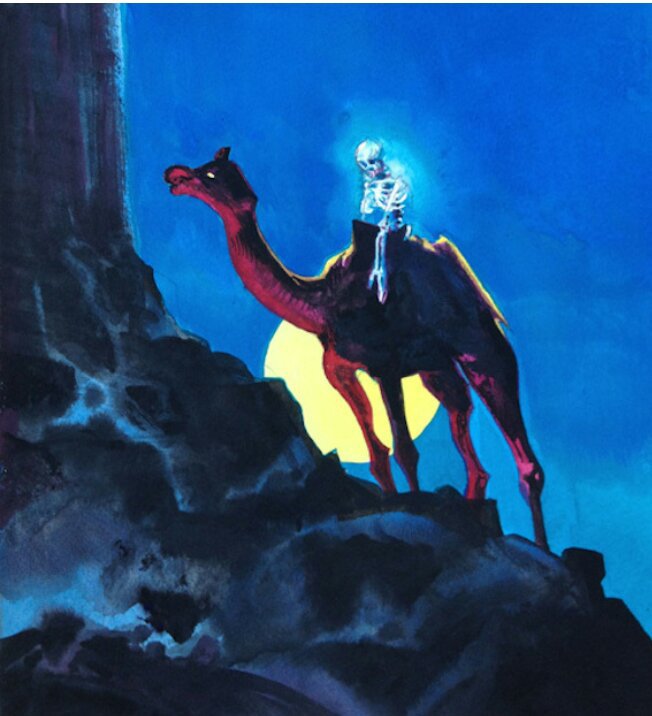
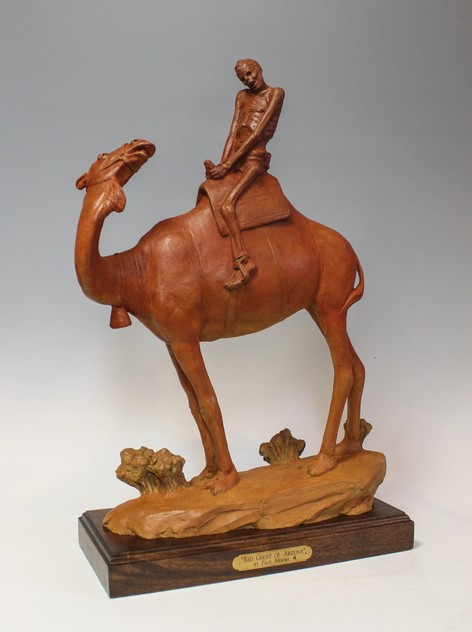
The Red Ghost terrorized Arizona during the 1880’s. The first reported appearance is in 1883, when it trampled a woman to death and left traces of red hair stuck to nearby tall grass at the scene. Later, a cowboy tried to rope the beast, but it turned and charged him, killing the man and his mount. A group of miners pursued it along the Verde River. It evaded capture, but shook something loose off of its back, a rotted human skull with dried skin and patches of hair stuck to it.

As sightings continued, the legend grew. Most described it as a great red demon with the devil himself riding on its back. Some witnesses claimed it was 30 feet tall. Other stories said that it had fought and devoured a grizzly, and that it could vanish before your eyes.

The Red Ghost’s reign of terror finally ended when a rancher in Eagle Creek caught it feasting on vegetables in his garden and shot at it, killing it dead. It was then that the Ghost’s true nature was revealed. It was a large camel, with gruesome straps of rawhide criss-crossing and digging into its body. The rawhide straps were apparently used to lash a human body, now in extreme decay, to the camel’s back. But how did such a creature in up in late 19th century Arizona?

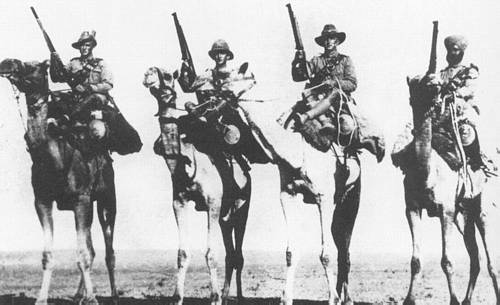
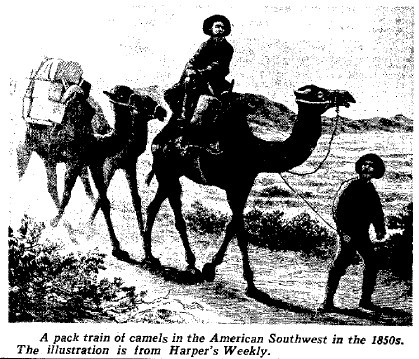
For that answer, we have to go back decades, to a pre-Civil War America. In 1853, Secretary of War and future Confederate president, Jefferson Davis got approval from Congress, after much lobbying, to spend $30,000 on the importation of camels and dromedaries for military purposes. This was still decades before the transcontinental railroad, and Davis saw the camels as the key to westward expansion, especially through the arid southwest deserts. By 1857, 75 camels had been imported to America under the plan. Unfortunately, within a decade the initiative would be scrapped and all camels auctioned off.

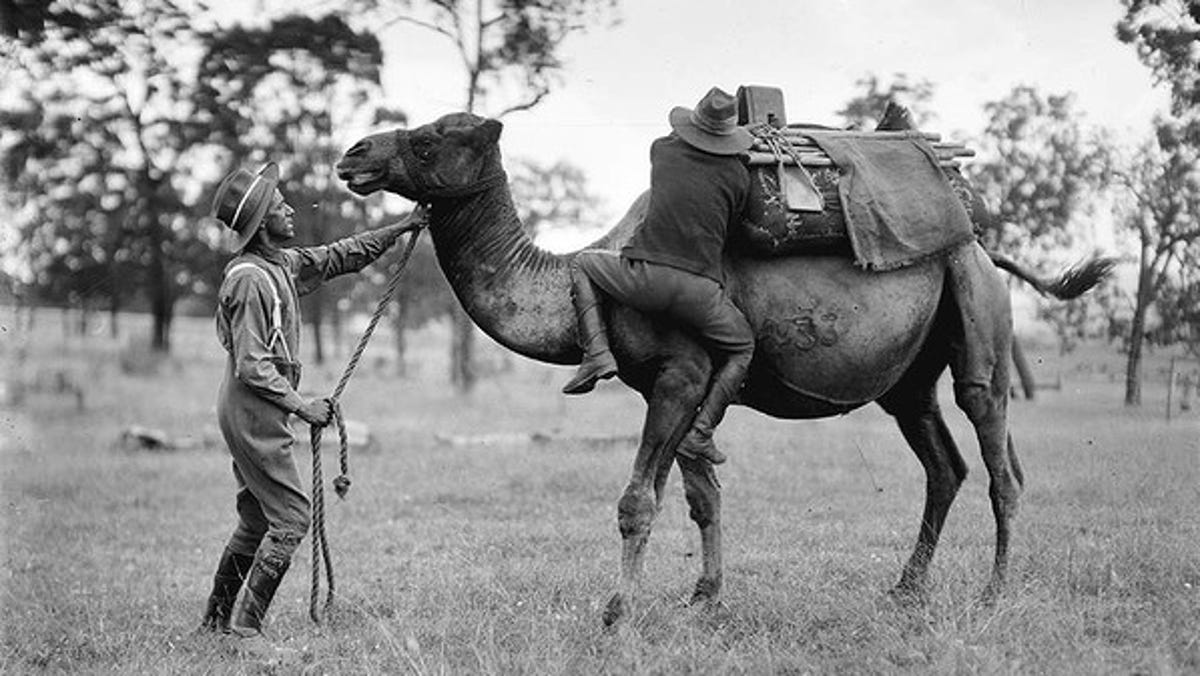
Despite its epitaph, the program was largely successful. The camels were stationed with a U.S. Army at Camp Verde in Texas. The camels’ primary use was to strengthen current travel routes and poke and prod out new ones west to the Pacific and south to Mexico.

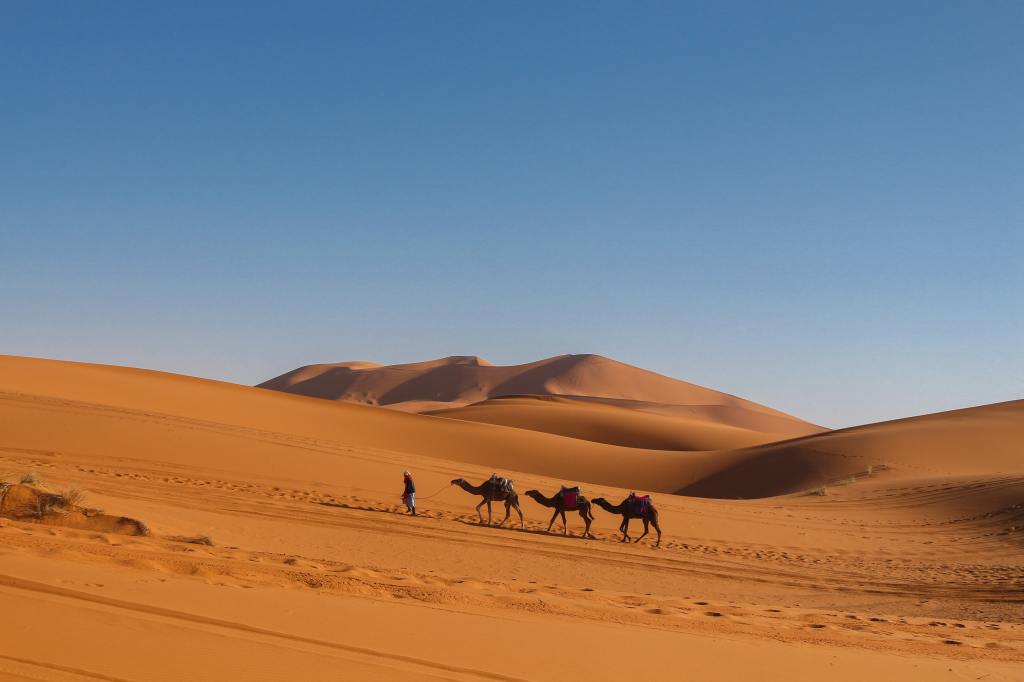
Two dozen of these camels made the famous trek to Fort Tejon outside Los Angeles under the usage of hero of the west Edward Beale. Beale’s troupe made the 1500 mile trek in just three months, a feat considered impossible at the time. The route discovered by Beale’s camel caravan was used to create the Beale Wagon Road, guiding thousands of settlers out west, and parts were adopted to make the Santa Fe Railroad’s contribution to the transcontinental railroad, and eventually Route 66 and Interstate 40.

The camels did have downsides, though. They were renowned for scaring the hell out of the horses, and given half-a-chance would just wander off overnight. Of course, this is all to say nothing of a pack animal that can spit with pinpoint accuracy at any handler it doesn’t agree with.

But the real straw that broke the camel program’s back came as Congress became afraid to pursue further importation of the animals due to pressure placed on them from lobbyists in the mule industry. Though this was plenty, further complications came from the secession of Texas and the South, causing Camp Verde to fall into the hands of the Confederacy. Left to Confederate care, the camels’ security was more lax, and many if them simply wandered off when let loose to graze.

The camel unit quickly scattered throughout the region. Union forces re-captured three of the beasts in Arkansas, but quickly auctioned then off. Some camels made it to Mexico, reportedly. A few found employment in the Confederate Postal Service. One, nicknamed Old Douglas, became the property of the 43rd Mississippi Infantry and was killed during the siege of Vicksburg, an act which so enraged Confederste Colonel Bevier that he tasked six of his best snipers with identifying and killing the Union sharpshooter that gunned Douglas down.

Some escaped camels turned feral and survived in the wilderness, but they never had enough numbers to provide a thriving and lasting sustainable herd. People would have chance encounters with these wild camels from time-to-time, the last report of such coming from the mid-20th century.

The origin of The Red Ghost himself is still something of a mystery. One rumor is that the rider was an Army soldier who was deathly afraid of the camels, so his fellow soldiers tied him to the back so he wouldn’t have to worry about falling off. Unfortunately, the beast took off and the soldiers were unable to keep up pursuit.

This seems a pretty poor explanation under scrutiny, though, because it relies on a soldier being tied on top in such a way that he couldn’t get himself off. It’s hard to image an arrangement under friendly intentions where the rider would not be given means to remove himself from the beast’s back. 

Another tale tells of a rider that was too tired to hold onto the beast and decide to tie himself on instead, but again that would leave us a rider that should be able to get himself loose before death set in. A more likely incident might be a screwball episode of frontier justice, or maybe a death sentence created by a particularly creative and sadistic outlaw, either one a situation where an individual would be attached to an animal without means of removing themselves, then the animal set loose with no destination in mind. Whatever the story, the rider’s fate and identity were never discovered. And despite The Red Ghost’s capture and killing, reports of a red camel being ridden by a skeleton persisted for years afterwards.

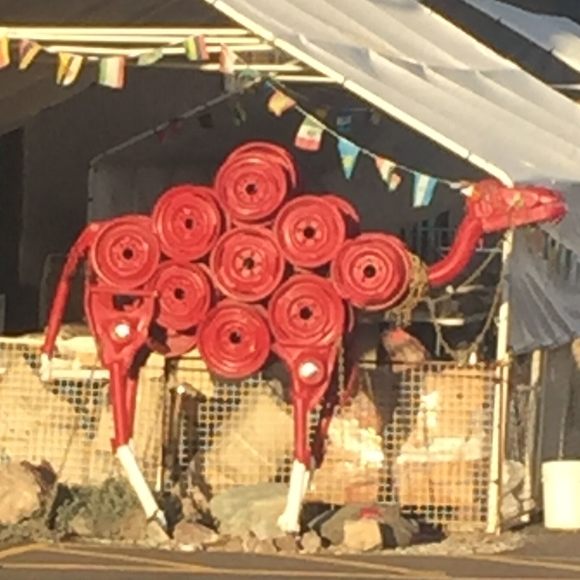
Today, a bright red scrap metal sculpture of The Red Ghost sits in Quartzside, AZ, where it has been lovingly named Georgette. Old Douglas has a grave in Cedar Hill Cemetery in Vicksburg, Mississippi, somehow fittingly as it’s Jefferson Davis’s hometown.

Interestingly enough, though, another ghost story has sprung forth from the history of these imported camels. Three camels were purportedly purchased from an Army auction by a prospector by the name of Jake. The soldiers warned Jake that the camels were quite ornery, but Jake took good care of them and never had anything but praise for them and their behavior.

Eventually, Jake hit pay dirt and led his camels into town, laden in gold for the exchange. This caught the attention of a would-be claim jumper named Paul Adams. He heard of Jake’s success and decided to follow him and his camels out of town.

Jake was smart enough to not head directly to his claim, and instead took a long, circular route, so long that he ended up having to camp for the night. Mistaking the temporary camp site for the actual gold claim, Adams snuck in and murdered Jake. Trying to protect his owner, one of the camels attacked Adams, biting him, but eventually getting gunned down as well.

It wasn’t long before Adams realized his mistake, that this wasn’t the claim, and spent the next few days searching the nearby area, vainly trying to locate the real spot. It was on one night of searching that Paul Adams was awoken and saw the ghost of Jake on the back of his camel looking over the murderer. He quickly mounted his horse and fled, but the galloping camel continued the chase, unrelenting until Adams rode into town. Adams was so frightened he confessed all his deeds in exchange for the protection of a sheriff’s jail cell.

Photo by Isabelle Henriques from Pexels